


Press Releases
LaunchPoint Granted Patent for Hybrid Power System in Electric Flight
LaunchPoint at Forefront of the Global Electrification of Aviation
•
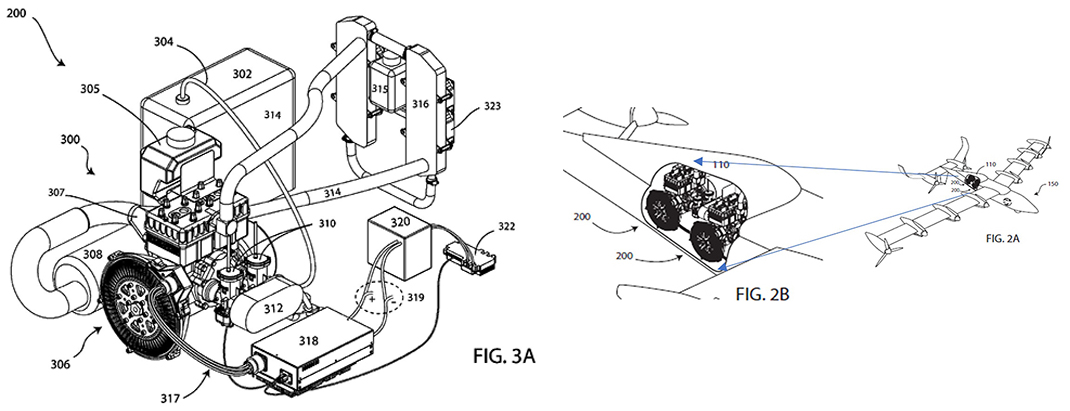
GOLETA, California – OCTOBER 25, 2023 – LaunchPoint Electric Propulsion Solutions, Inc. (“LaunchPoint”), a pioneer in advanced aerospace electric power generation and propulsion technologies, announced today the grant of US Patent 11,738,875 B2 “Lightweight, High-Efficiency, Energy-Dense, Hybrid Power System for Reliable Electric Flight”. This patent is a significant milestone in LaunchPoint’s greater mission to revolutionize electric flight and propel the aerospace industry into a new era of efficiency and reliability.
At its core, the patent describes an innovative system engineered to deliver power-dense, efficient, and reliable power for electric aircraft, supporting onboard applications as well as driving rotors and propellers for lift and thrust. This technology has significant applications for drones and electric vertical takeoff and landing (eVTOL) vehicles, enabling efficient transportation of cargo and passengers.
Electric propulsion holds immense promise for aircraft due to electric motors’ superior power-to-weight ratio compared to piston or turbine engines, enabling placement in aerodynamically favorable positions on aircraft. However, the limitation of electric aircraft propulsion comes from the need for electric energy storage in the form of batteries which are heavy and bulky. Typically, battery powered aircraft can only fly relatively short distances. For extended-duration flights, the battery electric propulsion concept proves unsuitable, and it has become universally known that the overall best solution is a hybrid-electric propulsion system.
The patented LaunchPoint Hybrid Power System (HPS) extends flight time coveted by most aircraft missions and allows increased payload for long duration missions. The system combines an internal combustion engine with LaunchPoint’s dual Halbach array generator and a small battery pack to power a distributed electric drive system. It includes vital cutting-edge energy and power management software tailored for various aircraft missions. In short, the LaunchPoint HPS elevates system-specific power while reducing energy storage mass. Moreover, the system excels in regulating variable voltage sources such as permanent magnet generators while functioning as a microgrid power manager, optimizing energy resources for reliable and fault-tolerant flight. Multiple systems can be used in parallel on the same DC Bus to achieve redundancy and availability goals.
Mike Ricci, Chief Technology Officer at LaunchPoint states, “The LaunchPoint HPS took over a decade to evolve to meet the rigorous demands of Advanced Air Mobility (AAM) and unmanned aerial vehicles (UAV). Our innovative hybrid technology addresses these demands by utilizing energy-dense liquid fuel, outperforming traditional battery only powered systems. This pioneering approach extends the range and efficiency of electric aircraft, overcoming the inherent limitations of battery-only solutions.”
“The LaunchPoint Hybrid Power System represents an excellent solution for our customers seeking generator-driven power solutions or those looking to leverage LaunchPoint’s generators and controllers to develop their power generation solutions. It is a testament to our commitment to innovation and addressing the challenges of electric flight.”
About LaunchPoint Electric Propulsion Solutions
LaunchPoint is a leading aerospace solutions company that provides patented electric power generation and propulsion technologies in a scalable range of solutions for defense and commercial aerospace sectors. Since its establishment in 2020, LaunchPoint has steadily grown its team and brand as an innovative system solutions provider for established global customers.
LaunchPoint Granted Patent for Hybrid Power System in Electric Flight
LaunchPoint at Forefront of the Global Electrification of Aviation
•
GOLETA, California – OCTOBER 25, 2023 – LaunchPoint Electric Propulsion Solutions, Inc. (“LaunchPoint”), a pioneer in advanced aerospace electric power generation and propulsion technologies, announced today the grant of US Patent 11,738,875 B2 “Lightweight, High-Efficiency, Energy-Dense, Hybrid Power System for Reliable Electric Flight”. This patent is a significant milestone in LaunchPoint’s greater mission to revolutionize electric flight and propel the aerospace industry into a new era of efficiency and reliability.
At its core, the patent describes an innovative system engineered to deliver power-dense, efficient, and reliable power for electric aircraft, supporting onboard applications as well as driving rotors and propellers for lift and thrust. This technology has significant applications for drones and electric vertical takeoff and landing (eVTOL) vehicles, enabling efficient transportation of cargo and passengers.
Electric propulsion holds immense promise for aircraft due to electric motors’ superior power-to-weight ratio compared to piston or turbine engines, enabling placement in aerodynamically favorable positions on aircraft. However, the limitation of electric aircraft propulsion comes from the need for electric energy storage in the form of batteries which are heavy and bulky. Typically, battery powered aircraft can only fly relatively short distances. For extended-duration flights, the battery electric propulsion concept proves unsuitable, and it has become universally known that the overall best solution is a hybrid-electric propulsion system.
The patented LaunchPoint Hybrid Power System (HPS) extends flight time coveted by most aircraft missions and allows increased payload for long duration missions. The system combines an internal combustion engine with LaunchPoint’s dual Halbach array generator and a small battery pack to power a distributed electric drive system. It includes vital cutting-edge energy and power management software tailored for various aircraft missions. In short, the LaunchPoint HPS elevates system-specific power while reducing energy storage mass. Moreover, the system excels in regulating variable voltage sources such as permanent magnet generators while functioning as a microgrid power manager, optimizing energy resources for reliable and fault-tolerant flight. Multiple systems can be used in parallel on the same DC Bus to achieve redundancy and availability goals.
Mike Ricci, Chief Technology Officer at LaunchPoint states, “The LaunchPoint HPS took over a decade to evolve to meet the rigorous demands of Advanced Air Mobility (AAM) and unmanned aerial vehicles (UAV). Our innovative hybrid technology addresses these demands by utilizing energy-dense liquid fuel, outperforming traditional battery only powered systems. This pioneering approach extends the range and efficiency of electric aircraft, overcoming the inherent limitations of battery-only solutions.”
“The LaunchPoint Hybrid Power System represents an excellent solution for our customers seeking generator-driven power solutions or those looking to leverage LaunchPoint’s generators and controllers to develop their power generation solutions. It is a testament to our commitment to innovation and addressing the challenges of electric flight.”
About LaunchPoint Electric Propulsion Solutions
LaunchPoint is a leading aerospace solutions company that provides patented electric power generation and propulsion technologies in a scalable range of solutions for defense and commercial aerospace sectors. Since its establishment in 2020, LaunchPoint has steadily grown its team and brand as an innovative system solutions provider for established global customers.
From Humble Beginnings to Aerospace Powerhouse
LaunchPoint Announces Expansion to New Corporate Headquarters and Exciting Job Opportunities•
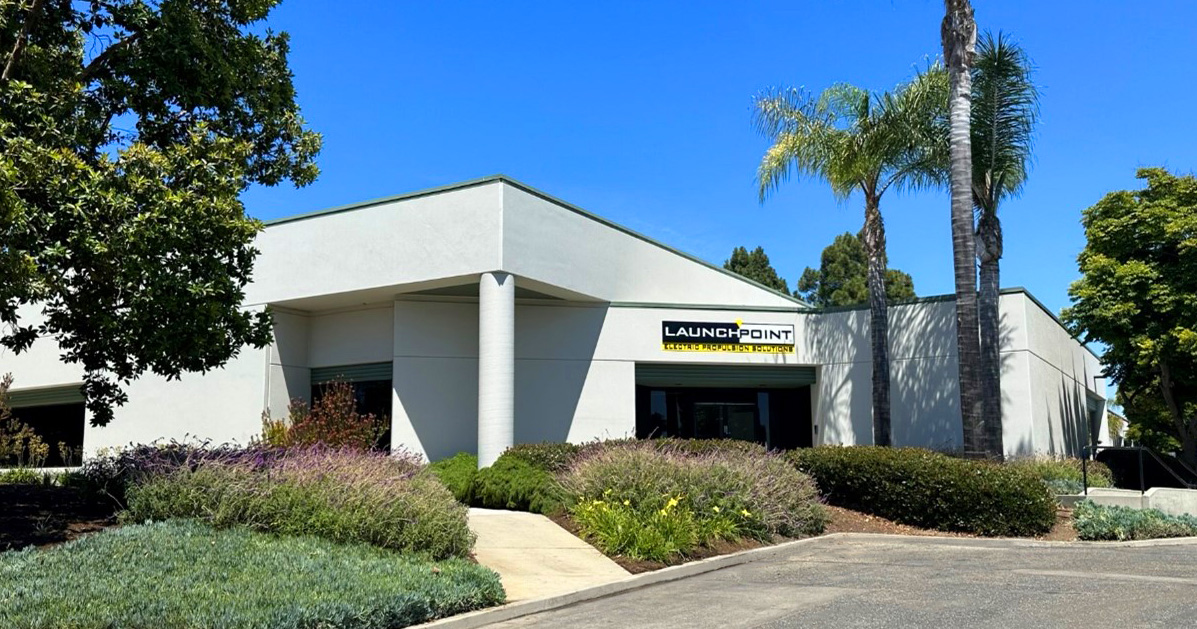
GOLETA, California – AUGUST 9, 2023 – LaunchPoint Electric Propulsion Solutions, Inc. (“LaunchPoint”), a leading innovator in cutting-edge aerospace electric power generation and propulsion technologies, is thrilled to unveil its expansion to a new, state-of-the-art corporate headquarters in Goleta, Calif. The move to a larger, custom-built facility marks an exciting milestone for the company and underscores its commitment to better serving its aerospace industry customers as well as its growing workforce.
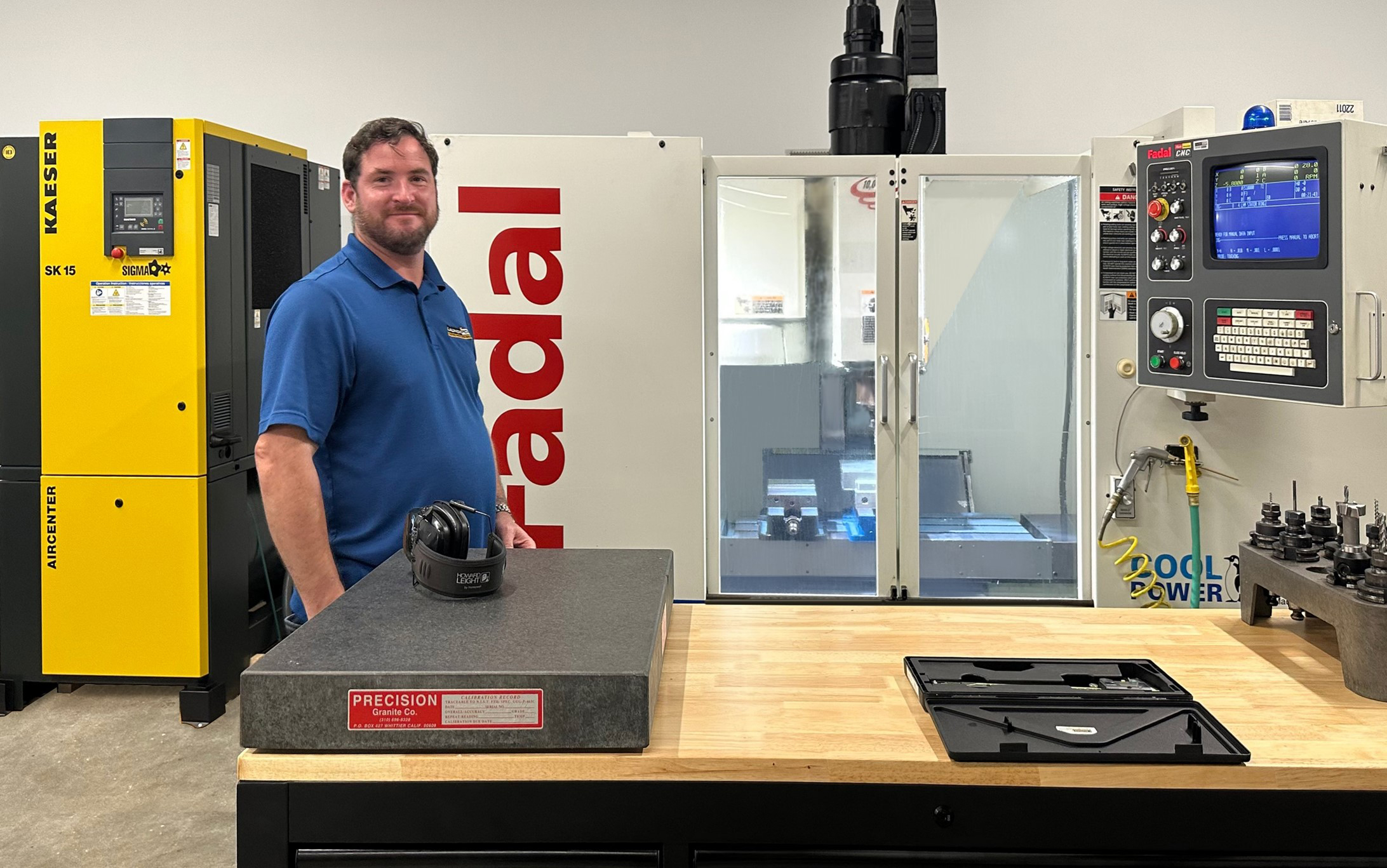
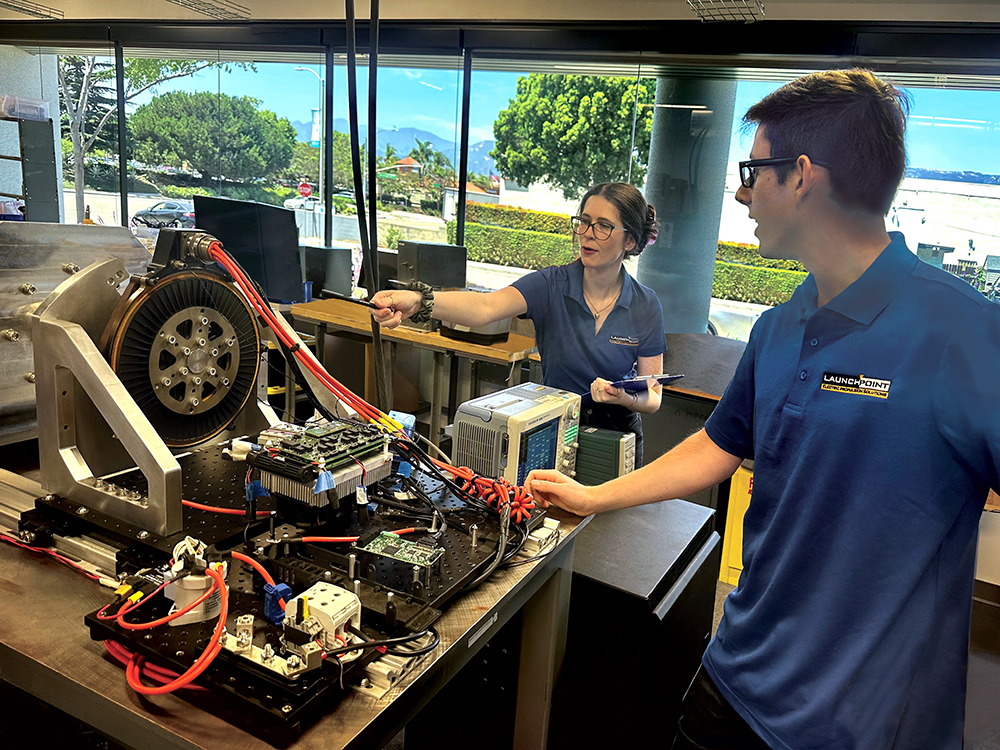
Situated at the heart of Goleta’s thriving tech and engineering corridor and close to the University of California, Santa Barbara, the expanded corporate headquarters is thoughtfully designed to meet the surging demands of LaunchPoint’s customer base. Outfitted with cutting-edge engineering, manufacturing, and testing spaces, the facility serves as a catalyst for pioneering advancements in defense and commercial markets. Here, LaunchPoint’s passionate engineers find the perfect ecosystem to foster visionary concepts, unlocking new possibilities for the future of aerospace.
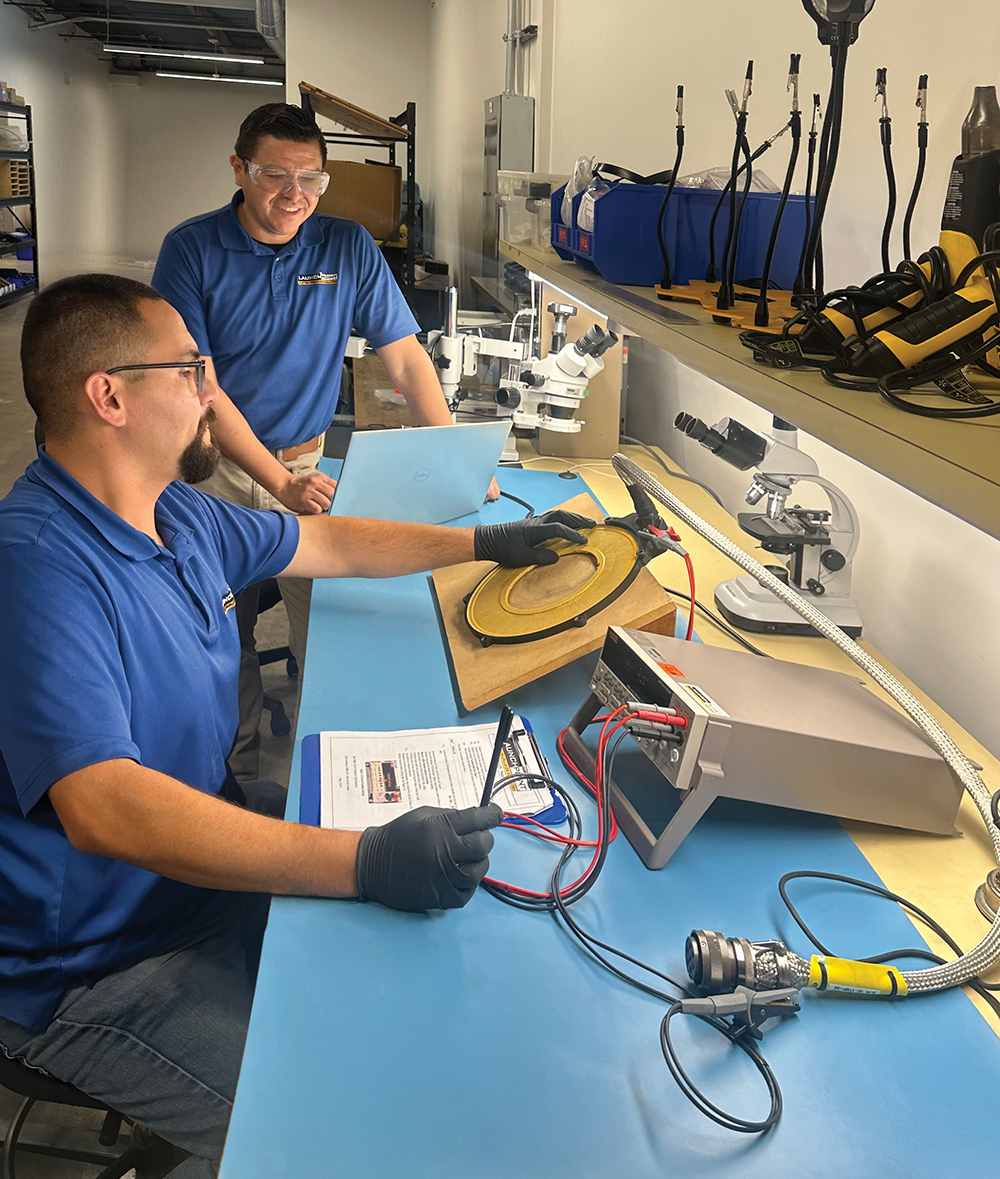
Aligned with LaunchPoint’s customer-centric ethos, advanced manufacturing units ensure swift fulfillment of customer orders, certifying that every product meets the highest quality standards.
“Our journey from humble beginnings to our current position as a key player in the aerospace industry has been nothing short of remarkable,” said Rob Reali, LaunchPoint’s CEO. “This expansion reflects our continued dedication to providing top-notch aerospace solutions with greatly increased testing and manufacturing capabilities. We are immensely proud of the progress we’ve made, including local job creation for the community and the acquisition of large programs with tier one customers. And it’s all thanks to the hard work and dedication of our incredible team.”


LaunchPoint has experienced extraordinary growth, more than tripling its personnel since spinning out from LaunchPoint Technologies in 2020. The new headquarters will not only accommodate the existing team but also allow the company to further scale its workforce.
LaunchPoint is looking to add a significant number of technical and manufacturing employees as both government and commercial programs increase into 2024.
For current job opportunities with LaunchPoint, visit https://launchpointeps.com/careers/
About LaunchPoint Electric Propulsion Solutions
LaunchPoint is a leading aerospace solutions company that provides patented electric power generation and propulsion technologies in a scalable range of solutions for defense and commercial aerospace markets. Since its establishment in 2020, LaunchPoint has steadily grown its team and brand as an innovative system solutions provider for established global customers.
LaunchPoint Returns to the World’s Leading International Technical Event on Vertical Flight Technology

GOLETA, California – LaunchPoint Electric Propulsion Solutions, Inc. is pleased to announce its return to the Vertical Flight Society’s (VFS) 78th Annual Forum and Technology Display, being held in Fort Worth, Texas, USA from May 10 to 12, 2022. The LaunchPoint Team is co-presenting two technical papers in the electric vertical takeoff and landing (eVTOL) Technical Session I on Tuesday morning, May 10. Michael Ricci, LaunchPoint’s Chief Technology Officer and co-founder is also co-instructing the VFS’s signature Short Course on Electric VTOL Technology.
LaunchPoint has partnered with one of its customers to explore hybrid-electric propulsion as a promising technology to achieve excellent overall vehicle performance. In “Power System Characterization and Flight Testing of a >55 lb. Hybrid-Electric Multirotor”, details of the LaunchPoint hybrid-electric power system are presented in addition to results of flight tests showing aircraft endurance improvements with a hybrid system over a pure electric version of the same aircraft. The aircraft tested was the customer’s unmanned quadcopter equipped with LaunchPoint’s 5.5 kW HPS055 hybrid-electric power system.
LaunchPoint has also teamed up with Dr. Jayant Sirohi, a professor at the University of Texas Austin, and UT Austin graduate student, Matthew Asper, to propose a radical new concept for thrust control of a fixed-pitch rotor that may facilitate the use of electric power in vertical flight aircraft. As described in “Electromechanical Modeling and Testing of a Phase-Controlled Stacked Rotor,” the concept involves using phase-controlled (or position controlled) rotors stacked on top of each other and changing the index angle of the rotor system in flight.
Michael Ricci, a member of the VFS’s eVTOL committee since its founding in 2019, will be discussing advanced high-power hybrid-electric hardware in the upcoming VFS’ annual Short Course on Electric VTOL Technology on Monday, May 9, 2022. The course provides an overview of the unique challenges and opportunities of this new class of vehicles. Both electric and hybrid-electric aircraft will be covered for a variety of missions ranging from personal/private use to urban air taxis and regional electric VTOL bizjets.
“LaunchPoint EPS is on the forefront of innovation for electric flight,” says Mike Hirschberg, VFS’s Executive Director. “We have been so pleased to work with Michael Ricci and LaunchPoint for several years to advance the state of the art—and the state of understanding—of electric and hybrid-electric power and propulsion.”
To view the full schedule of events for the Vertical Flight Society’s 78th Annual Forum visit www.vtol.org/forum
LaunchPoint Returns to the World’s Leading International Technical Event on Vertical Flight Technology
GOLETA, California – LaunchPoint Electric Propulsion Solutions, Inc. is pleased to announce its return to the Vertical Flight Society’s (VFS) 78th Annual Forum and Technology Display, being held in Fort Worth, Texas, USA from May 10 to 12, 2022. The LaunchPoint Team is co-presenting two technical papers in the electric vertical takeoff and landing (eVTOL) Technical Session I on Tuesday morning, May 10. Michael Ricci, LaunchPoint’s Chief Technology Officer and co-founder is also co-instructing the VFS’s signature Short Course on Electric VTOL Technology.
LaunchPoint has partnered with one of its customers to explore hybrid-electric propulsion as a promising technology to achieve excellent overall vehicle performance. In “Power System Characterization and Flight Testing of a >55 lb. Hybrid-Electric Multirotor”, details of the LaunchPoint hybrid-electric power system are presented in addition to results of flight tests showing aircraft endurance improvements with a hybrid system over a pure electric version of the same aircraft. The aircraft tested was the customer’s unmanned quadcopter equipped with LaunchPoint’s 5.5 kW HPS055 hybrid-electric power system.
LaunchPoint has also teamed up with Dr. Jayant Sirohi, a professor at the University of Texas Austin, and UT Austin graduate student, Matthew Asper, to propose a radical new concept for thrust control of a fixed-pitch rotor that may facilitate the use of electric power in vertical flight aircraft. As described in “Electromechanical Modeling and Testing of a Phase-Controlled Stacked Rotor,” the concept involves using phase-controlled (or position controlled) rotors stacked on top of each other and changing the index angle of the rotor system in flight.
Michael Ricci, a member of the VFS’s eVTOL committee since its founding in 2019, will be discussing advanced high-power hybrid-electric hardware in the upcoming VFS’ annual Short Course on Electric VTOL Technology on Monday, May 9, 2022. The course provides an overview of the unique challenges and opportunities of this new class of vehicles. Both electric and hybrid-electric aircraft will be covered for a variety of missions ranging from personal/private use to urban air taxis and regional electric VTOL bizjets.
“LaunchPoint EPS is on the forefront of innovation for electric flight,” says Mike Hirschberg, VFS’s Executive Director. “We have been so pleased to work with Michael Ricci and LaunchPoint for several years to advance the state of the art—and the state of understanding—of electric and hybrid-electric power and propulsion.”
To view the full schedule of events for the Vertical Flight Society’s 78th Annual Forum visit www.vtol.org/forum
LaunchPoint™ Announces Hybrid Power System for Aircraft and Drone Industries
Generator and Controller products target prime mover OEM for electric vertical takeoff and landing (eVTOL) vehicles
•
 •
•
GOLETA, California – LaunchPoint Electric Propulsion Solutions, Inc., an aerospace power generation and electric propulsion design company, announced today the commercialization of its patent-pending, hybrid electric power system for aircraft.
The LaunchPoint™ Hybrid Power System (HPS) is a revolutionary ecosystem of complex motor and controller hardware, plus software for eVTOL aircraft of all types. The system increases flight performance beyond what battery-only or engine-only-powered flight can deliver. It uses a combination of an internal combustion engine and a battery electric distributed drive system for propulsion that increases system-specific power and decreases energy storage mass.
“Simply put, the LaunchPoint™ HPS is the brawn and brains of a power system of what would be characterized as the equivalent of a ‘flying Prius’ with cruise control – optimized for vehicle range, payload, flight/hover time and battery life,” said Rob Reali, LaunchPoint’s Chief Executive Officer. “Our novel arrangements of component features and innovations meet the needs of the emerging Advanced Air Mobility (AAM) market.”
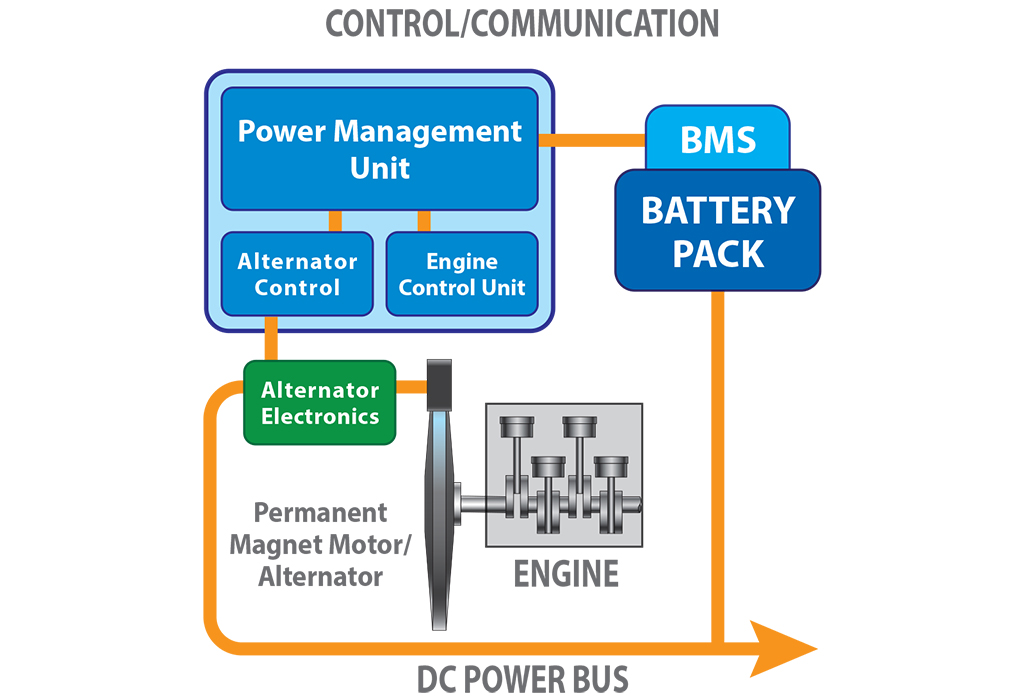
The HPS product family consists of electric motors, generators, drives, controllers, and hybrid electric power management units (PMU) designed for power generation and fully electric and hybrid electric propulsion applications. The system is designed to support both Parallel and Series hybrid operations.
“We’ve evolved the HPS over twelve years to meet the complexities of demanding flight and safety requirements for AAM and unmanned aerial systems (UAS),” said LaunchPoint’s Chief Technology Officer, Mike Ricci. “The integrated electromechanical system utilizes our proprietary SmartPoint™ control software to coordinate complex, dynamic hardware components, including the engines/prime movers, and intelligently respond to a wide range of system requirements in real time. The system not only solves the problem of regulating variable voltage sources – such as PM generators and fuel cells – but it also works together as a microgrid power manager to optimally use energy resources on a vehicle. Power is rerouted to enable reliable, fault-tolerant flight. It is an excellent system for our customers that want to run generators and for those who are looking to develop power generation solutions based on LaunchPoint’s generators and controllers.”
LaunchPoint™ HPS products range from 1.5 kW to 40 kW to power UAS. Systems for passenger and large cargo air mobility applications are customized solutions in the 40 kW to 250 kW range, and higher. Customized solutions are all modeled using LaunchPoint’s Modeling Advanced Aircraft Propulsion (MAAP™) proprietary software suite, which optimizes how a powertrain or electrical power system is architected.
In addition, the company has made the individual parts of its Hybrid Power System available for licensing and OEM sales.
The Hybrid Power System consists of:
• Permanent magnet motor/alternator
• Customer specified engine/prime mover (ICEs, turbines, fuel cells, etc.)
• Customer specified battery pack
• Power Management Unit
• High Voltage Alternator Controller
• Battery Management System
Features:
• Microprocessor-based system with proprietary software that monitors all functions
• Power Management Capability
• Recharge: Enables in-flight recharging of battery pack
• Power: Manages combined battery/generator power on DC bus
• Monitor: a digital “fuel gauge” measures all cell voltages and temperatures and state of charge (SOC) measurement capability
• Fault Condition: Manages the integrated intelligence to disconnect faulted/failed subsystems from DC Bus in real time
• Battery Management: Processes sensor data to derive battery pack measurements
• Proprietary Control Modes
• Rotor sync capability between multiple motors/drives + rotor position control mode
• PWM frequencies >100 kHz Support
• Sensorless + once around and Hall sensor + once around control modes
• Engine/DC Bus Power Control
• Engine control interface via PWM or serial data link
• Choke control for starting
• Starter signal for external starter motor applications
• DC bus and logic power voltage sensing for flight instrumentation
• Comprehensive Onboard Diagnostics and Fault Detection + Reporting
LaunchPoint™ Announces Hybrid Power System for Aircraft and Drone Industries
Generator and Controller products target prime mover OEM for electric vertical takeoff and landing (eVTOL) vehicles
•
•
GOLETA, California – LaunchPoint Electric Propulsion Solutions, Inc., an aerospace power generation and electric propulsion design company, announced today the commercialization of its patent-pending, hybrid electric power system for aircraft.
The LaunchPoint™ Hybrid Power System (HPS) is a revolutionary ecosystem of complex motor and controller hardware, plus software for eVTOL aircraft of all types. The system increases flight performance beyond what battery-only or engine-only-powered flight can deliver. It uses a combination of an internal combustion engine and a battery electric distributed drive system for propulsion that increases system-specific power and decreases energy storage mass.
“Simply put, the LaunchPoint™ HPS is the brawn and brains of a power system of what would be characterized as the equivalent of a ‘flying Prius’ with cruise control – optimized for vehicle range, payload, flight/hover time and battery life,” said Rob Reali, LaunchPoint’s Chief Executive Officer. “Our novel arrangements of component features and innovations meet the needs of the emerging Advanced Air Mobility (AAM) market.”
The HPS product family consists of electric motors, generators, drives, controllers, and hybrid electric power management units (PMU) designed for power generation and fully electric and hybrid electric propulsion applications. The system is designed to support both Parallel and Series hybrid operations.
“We’ve evolved the HPS over twelve years to meet the complexities of demanding flight and safety requirements for AAM and unmanned aerial systems (UAS),” said LaunchPoint’s Chief Technology Officer, Mike Ricci. “The integrated electromechanical system utilizes our proprietary SmartPoint™ control software to coordinate complex, dynamic hardware components, including the engines/prime movers, and intelligently respond to a wide range of system requirements in real time. The system not only solves the problem of regulating variable voltage sources – such as PM generators and fuel cells – but it also works together as a microgrid power manager to optimally use energy resources on a vehicle. Power is rerouted to enable reliable, fault-tolerant flight. It is an excellent system for our customers that want to run generators and for those who are looking to develop power generation solutions based on LaunchPoint’s generators and controllers.”
LaunchPoint™ HPS products range from 1.5 kW to 40 kW to power UAS. Systems for passenger and large cargo air mobility applications are customized solutions in the 40 kW to 250 kW range, and higher. Customized solutions are all modeled using LaunchPoint’s Modeling Advanced Aircraft Propulsion (MAAP™) proprietary software suite, which optimizes how a powertrain or electrical power system is architected.
In addition, the company has made the individual parts of its Hybrid Power System available for licensing and OEM sales.
The Hybrid Power System consists of:
• Permanent magnet motor/alternator
• Customer specified engine/prime mover (ICEs, turbines, fuel cells, etc.)
• Customer specified battery pack
• Power Management Unit
• High Voltage Alternator Controller
• Battery Management System
Features:
• Microprocessor-based system with proprietary software that monitors all functions
• Power Management Capability
• Recharge: Enables in-flight recharging of battery pack
• Power: Manages combined battery/generator power on DC bus
• Monitor: a digital “fuel gauge” measures all cell voltages and temperatures and state of charge (SOC) measurement capability
• Fault Condition: Manages the integrated intelligence to disconnect faulted/failed subsystems from DC Bus in real time
• Battery Management: Processes sensor data to derive battery pack measurements
• Proprietary Control Modes
• Rotor sync capability between multiple motors/drives + rotor position control mode
• PWM frequencies >100 kHz Support
• Sensorless + once around and Hall sensor + once around control modes
• Engine/DC Bus Power Control
• Engine control interface via PWM or serial data link
• Choke control for starting
• Starter signal for external starter motor applications
• DC bus and logic power voltage sensing for flight instrumentation
• Comprehensive Onboard Diagnostics and Fault Detection + Reporting
LaunchPoint Electric Propulsion Solutions Announces Achievement of Quality Standards Certifications AS9100 and ISO 9001
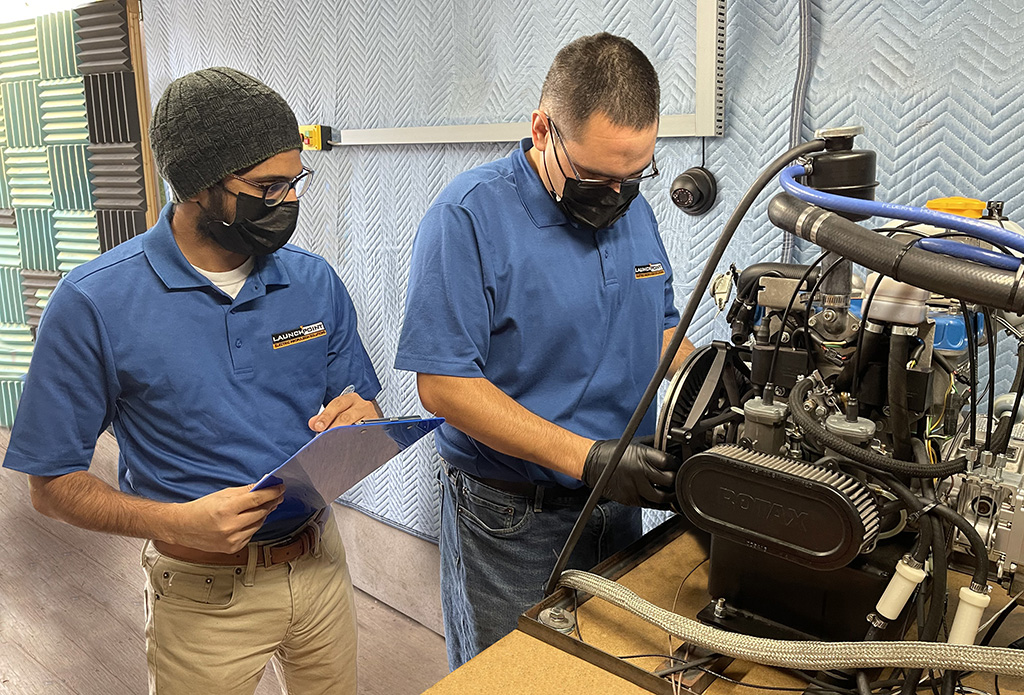
LaunchPoint engineers perform a routine quality check of an HPS400 40 kW GenSet
GOLETA, California – LaunchPoint Electric Propulsion Solutions, Inc., a leading developer of power generation and propulsion systems, has announced the achievement of both AS9100 and ISO 9001 certifications for its U.S. manufacturing facilities.
AS9100 is the internationally recognized Quality Management System standard specific to the aviation, space and defense industries. This standard is strongly supported and adhered to by all major aerospace contractors, also known as Original Equipment Manufacturers (OEMs), and is increasingly mandated for vendors like LaunchPoint within the supply chain.
Managed by the International Aerospace Quality Group, AS9100 certification is based on global quality management standards established by the International Organization for Standardization known as ISO 9001:2015. These standards signal to buyers that the product or service they are purchasing meets or exceeds internationally agreed-upon quality and safety requirements.
AS9100 encompasses the entirety of ISO 9001:2015 and adds an additional 80 requirements and 18 amplifications specific to aerospace business operations, from design and manufacturing to maintenance and distribution. Achieving both AS9100 and ISO 9001 certifications provides independent, internationally accredited, third-party validation of LaunchPoint’s commitment to meeting and exceeding the increasingly stringent industry requirements for aerospace-related products.
“LaunchPoint is very proud to have achieved this dual certification. It’s a reflection of our commitment and dedication to high-quality work,” said Chief Executive Officer Rob Reali. “Our AS9100 and ISO 9001 certifications underscore what I’ve always known is true at LaunchPoint: We manufacture only the highest quality and safest generators, motors and controllers for aerospace and defense applications for our customers.”
Certification to these standards enhances LaunchPoint’s competitive position and standardizes quality, reliability and safety processes throughout the organization. Maintaining certification requires the company to undergo annual surveillance audits by accredited third-party assessors, which will continue to validate the ongoing commitment to quality management.
LaunchPoint Quality Manager and U.S. Navy veteran Dean Young brings with him over three decades of combined quality assurance experience from Raytheon and the U.S. Air Force Civilian Service.
“The entire team at LaunchPoint was committed to seeing this standard met and certification achieved,” said Young. “I am proud of how we all came together as a company and not only embraced achieving certification, but also fully committed to continuous improvement as we move forward.”
LaunchPoint’s registration certificate can be viewed at
https://launchpointeps.com/quality/
LaunchPoint Electric Propulsion Solutions Announces Achievement of Quality Standards Certifications AS9100 and ISO 9001
LaunchPoint engineers perform a routine quality check of an HPS400 40 kW GenSet
GOLETA, California – LaunchPoint Electric Propulsion Solutions, Inc., a leading developer of power generation and propulsion systems, has announced the achievement of both AS9100 and ISO 9001 certifications for its U.S. manufacturing facilities.
AS9100 is the internationally recognized Quality Management System standard specific to the aviation, space and defense industries. This standard is strongly supported and adhered to by all major aerospace contractors, also known as Original Equipment Manufacturers (OEMs), and is increasingly mandated for vendors like LaunchPoint within the supply chain.
Managed by the International Aerospace Quality Group, AS9100 certification is based on global quality management standards established by the International Organization for Standardization known as ISO 9001:2015. These standards signal to buyers that the product or service they are purchasing meets or exceeds internationally agreed-upon quality and safety requirements.
AS9100 encompasses the entirety of ISO 9001:2015 and adds an additional 80 requirements and 18 amplifications specific to aerospace business operations, from design and manufacturing to maintenance and distribution. Achieving both AS9100 and ISO 9001 certifications provides independent, internationally accredited, third-party validation of LaunchPoint’s commitment to meeting and exceeding the increasingly stringent industry requirements for aerospace-related products.
“LaunchPoint is very proud to have achieved this dual certification. It’s a reflection of our commitment and dedication to high-quality work,” said Chief Executive Officer Rob Reali. “Our AS9100 and ISO 9001 certifications underscore what I’ve always known is true at LaunchPoint: We manufacture only the highest quality and safest generators, motors and controllers for aerospace and defense applications for our customers.”
Certification to these standards enhances LaunchPoint’s competitive position and standardizes quality, reliability and safety processes throughout the organization. Maintaining certification requires the company to undergo annual surveillance audits by accredited third-party assessors, which will continue to validate the ongoing commitment to quality management.
LaunchPoint Quality Manager and U.S. Navy veteran Dean Young brings with him over three decades of combined quality assurance experience from Raytheon and the U.S. Air Force Civilian Service.
“The entire team at LaunchPoint was committed to seeing this standard met and certification achieved,” said Young. “I am proud of how we all came together as a company and not only embraced achieving certification, but also fully committed to continuous improvement as we move forward.”
LaunchPoint’s registration certificate can be viewed at
https://launchpointeps.com/quality/
LaunchPoint Announces Commercialization of its 250 kW Motor Controller for Advanced Air Mobility
Santa Barbara-area company develops key, high-power technology for the rising air taxi markets
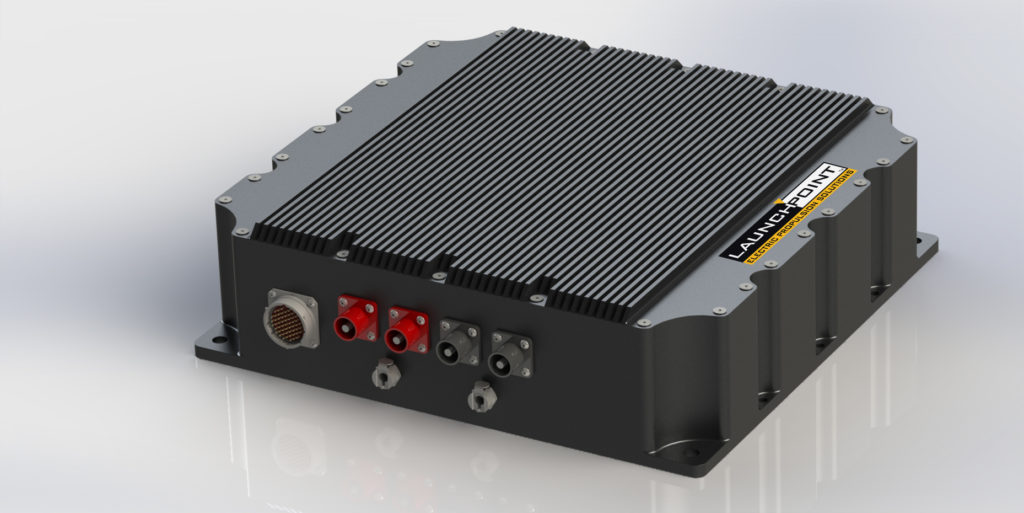
GOLETA, California – Top aerospace power generation and propulsion development company, LaunchPoint Electric Propulsion Solutions, Inc., is pleased to announce the commercialization of its highest power controller to date. The highly efficient MC250 is an ultra-lightweight, bi-directional 250 kW power electronics solution capable of controlling permanent magnet motor or generator power. Applications include electric propulsion and power generation for aircraft in defense, commercial aerospace, and advanced air mobility.
The MC250 is ideal to use as a power converter for high-speed motors or alternators. It is a high switching frequency converter based on SiC MOSFETs that enables high commutation frequency electric machines over the range of 690 V DC to 880 V DC maximum bus voltage. Weighing at just 9.0 kg including internal liquid cooling thermal management components, it is ultra-lightweight. It is also compact, measuring 381 mm x 281 mm x 152 mm.
“To date, our technologies have been tailored toward the UAV market, and at power level less than 100 kW, but the 250 kW controller now gets us in the higher power range where we can start moving people and significant cargo for defense and advanced air mobility applications,” said Mike Ricci, LaunchPoint’s Chief Technology Officer. “With this kind of power, you can move significant physical objects large distances and that capability has a massive impact.”
A high speed/high power alternator is currently in development to pair with the MC250 as a full turbo-alternator power generation solution. Near-term plans include options to be fully MIL-STD compliant or FAA DO-160 compliant.
“LaunchPoint was referred to our large customer as the supplier who could take on their 250 kW controller program. This occurred given our established reputation for solving extremely difficult systems engineering challenges in power generation and controls,” said Chris Grieco, LaunchPoint’s Sr. VP of Global Business Development & Sales. “Successfully taking our product line well into the power levels required for the advanced air mobility markets positions our company well as a future volume supplier.”
LaunchPoint’s controllers are advanced electric motor drives, generator controllers and hybrid electric power system management units designed for power generation and fully electric and hybrid electric propulsion applications. Other controller offerings include power levels of 6 kW, 15 kW and 40 kW.
Core Technology – Advanced SiC Controller
High efficiency high switching frequency
• Low current ripple, even with low inductance electric machines
• Ideal current waveform
• Fast control response
• Ideal for high pole count and high speed electric machines
Lightweight and compact
• SiC offers excellent power to weight
• SiC lowers losses for smaller heat exchangers
Smart – developed over a decade
• Fail-operational capabilities
• Comprehensive onboard diagnostics
• Real-time feedback via CAN bus
HPS055, 6 kW Hybrid System Controller
• 60 V DC Maximum Bus Rating (12S to 18S)
• 228.6 mm x 114.3 mm x 88.9 mm
• 5.0 kg including heat exchanger
MC250, 250 kW Generator Controller
• 880 V DC Maximum Bus Rating
• 381 mm x 381 mm x 152.4 mm
• 9.0 kg including heat exchanger
LaunchPoint Announces Commercialization of its 250 kW Motor Controller for Advanced Air Mobility
Santa Barbara-area company develops key, high-power technology for the rising air taxi markets
GOLETA, California – Top aerospace power generation and propulsion development company, LaunchPoint Electric Propulsion Solutions, Inc., is pleased to announce the commercialization of its highest power controller to date. The highly efficient MC250 is an ultra-lightweight, bi-directional 250 kW power electronics solution capable of controlling permanent magnet motor or generator power. Applications include electric propulsion and power generation for aircraft in defense, commercial aerospace, and advanced air mobility.
The MC250 is ideal to use as a power converter for high-speed motors or alternators. It is a high switching frequency converter based on SiC MOSFETs that enables high commutation frequency electric machines over the range of 690 V DC to 880 V DC maximum bus voltage. Weighing at just 9.0 kg including internal liquid cooling thermal management components, it is ultra-lightweight. It is also compact, measuring 381 mm x 281 mm x 152 mm.
“To date, our technologies have been tailored toward the UAV market, and at power level less than 100 kW, but the 250 kW controller now gets us in the higher power range where we can start moving people and significant cargo for defense and advanced air mobility applications,” said Mike Ricci, LaunchPoint’s Chief Technology Officer. “With this kind of power, you can move significant physical objects large distances and that capability has a massive impact.”
A high speed/high power alternator is currently in development to pair with the MC250 as a full turbo-alternator power generation solution. Near-term plans include options to be fully MIL-STD compliant or FAA DO-160 compliant.
“LaunchPoint was referred to our large customer as the supplier who could take on their 250 kW controller program. This occurred given our established reputation for solving extremely difficult systems engineering challenges in power generation and controls,” said Chris Grieco, LaunchPoint’s Sr. VP of Global Business Development & Sales. “Successfully taking our product line well into the power levels required for the advanced air mobility markets positions our company well as a future volume supplier.”
LaunchPoint’s controllers are advanced electric motor drives, generator controllers and hybrid electric power system management units designed for power generation and fully electric and hybrid electric propulsion applications. Other controller offerings include power levels of 6 kW, 15 kW and 40 kW.
Core Technology – Advanced SiC Controller
High efficiency high switching frequency
• Low current ripple, even with low inductance electric machines
• Ideal current waveform
• Fast control response
• Ideal for high pole count and high speed electric machines
Lightweight and compact
• SiC offers excellent power to weight
• SiC lowers losses for smaller heat exchangers
Smart – developed over a decade
• Fail-operational capabilities
• Comprehensive onboard diagnostics
• Real-time feedback via CAN bus
HPS055, 6 kW Hybrid System Controller
• 60 V DC Maximum Bus Rating (12S to 18S)
• 228.6 mm x 114.3 mm x 88.9 mm
• 5.0 kg including heat exchanger
MC250, 250 kW Generator Controller
• 880 V DC Maximum Bus Rating
• 381 mm x 381 mm x 152.4 mm
• 9.0 kg including heat exchanger
Aerospace Power and Propulsion Company, LaunchPoint, Announces Commercialization of its 1.5 kW Generator and Electric Motor for Advanced Drones
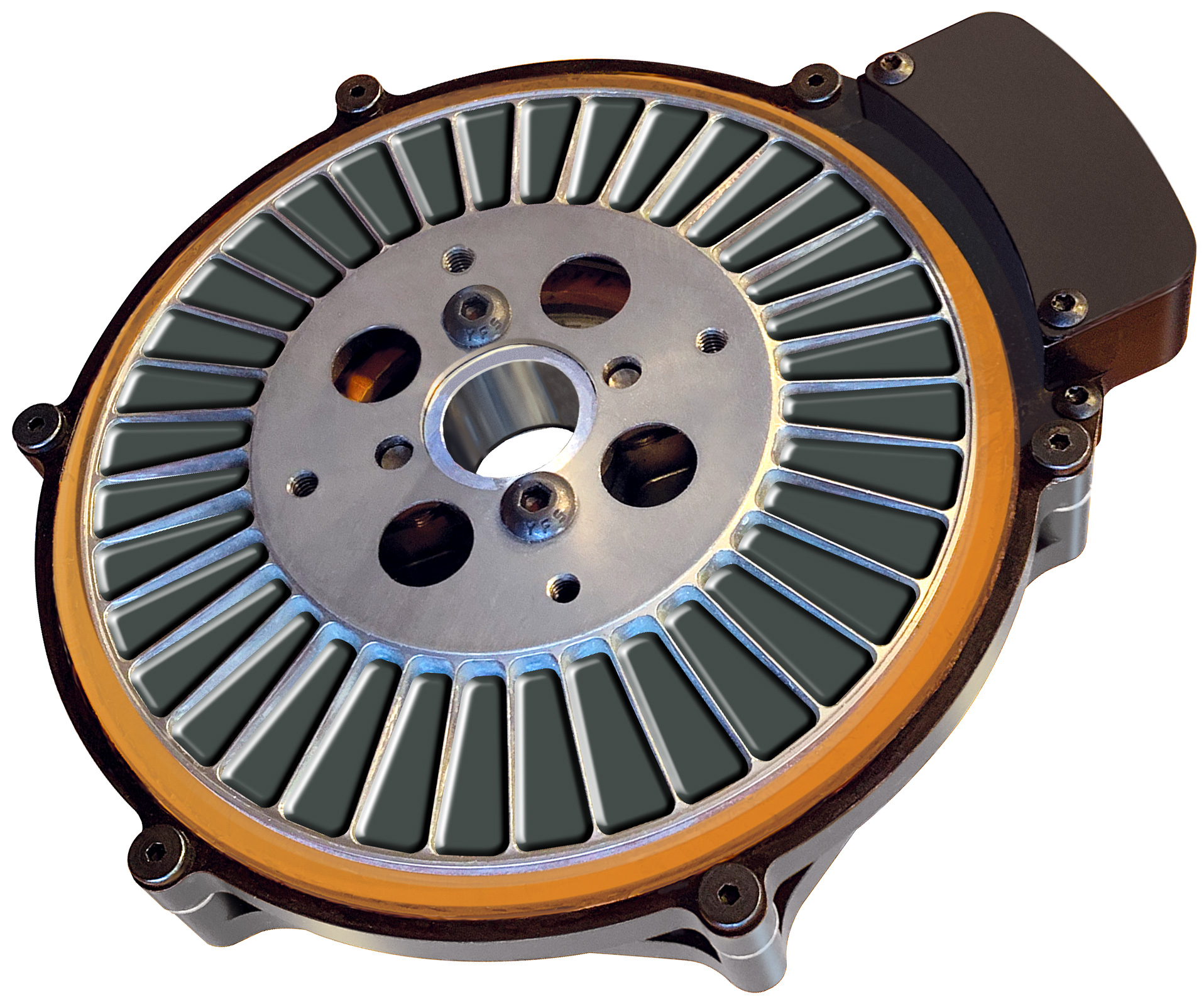
LaunchPoint’s DHA050 1.5 kW Electric Machine
GOLETA, California – LaunchPoint Electric Propulsion Solutions, Inc., a fast-growing aerospace and defense solutions company, has announced the commercialization of its next generation 1.5 kW electric generator and controller. Engineered to MIL-STD specification, the DHA050 enables increased onboard electrical power generation for advanced drones.
The 1.5 kW product is LaunchPoint’s most compact generator. It weighs 0.45 kg and has a specific power of 4.4 kW/kg at a continuous speed of 7,000 RPM. Other power-dense options currently in production and available today include 5.5 kW and 40 kW generators for aerospace customers having higher power needs. LaunchPoint’s higher power options have a specific power of 4.3 kW/kg and 6.9 kW/kg at continuous speeds of 6,250 RPM and 6,500 RPM respectively.
LaunchPoint developed its Gen 1 flagship product in 2018. Since then, engineers at the company have demonstrated airborne functionality of the 1.5 kW generator and controller systems. An advanced Gen 1 prototype has been flown together with an engine as a full hybrid electric GenSet as part of research and development efforts for extended-range flight. Following successful flights with Gen 1 and now due to surging market demand, LaunchPoint has finalized the next generation system for commercial use.
Applications for Gen 2 include onboard GenSets, alternators, and starter generators.
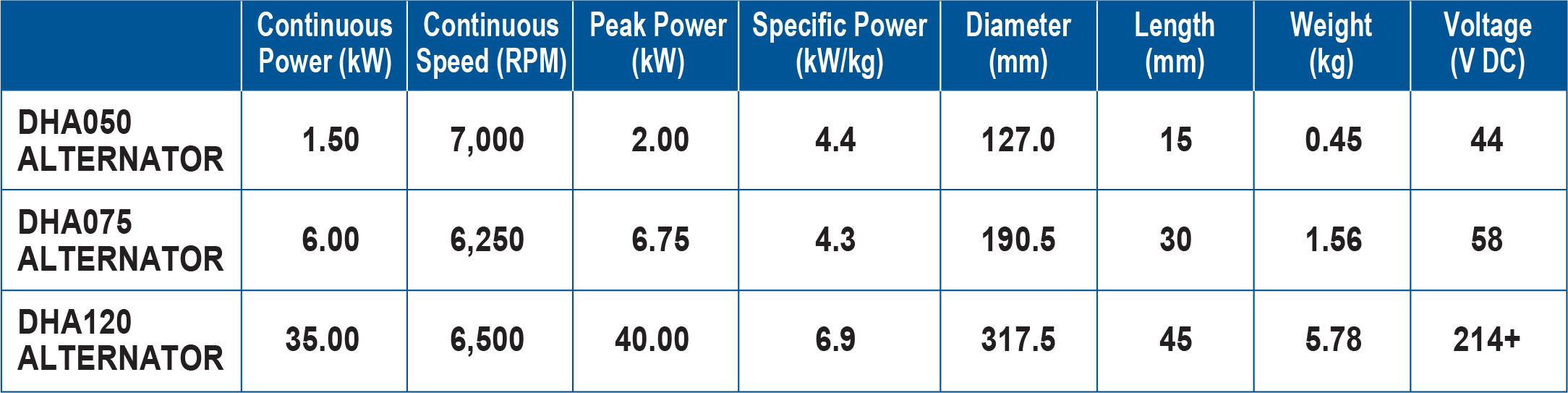
Specifications for LaunchPoint’s Electric Machines
“It became obvious from our meetings at AUVSI (Association for Unmanned Vehicle Systems International) Xponential 2021, that our proprietary electric power generation solution at this 1.5 kW power level will provide a great fit to near-term identified needs and immense value to customers in the defense sectors. Our products will help achieve future capabilities in very sophisticated airborne systems,” said Chris Grieco, LaunchPoint’s Senior Vice President of Business Development and Sales. “When voice of the customer and knowledge of the growing drone market’s needs converge on LaunchPoint’s technology as a very strong fit, we react.”
LaunchPoint is currently working with potential customers to incorporate their product specifications into development. An advanced Gen 2 prototype of the 1.5 kW generator and paired controller is expected to be ready for flight in Q1, 2022.
“We are prioritizing resources and moving full speed ahead to a product release for this capacity of generator,” Grieco said. “It’s a premium, lightweight, efficient and powerful product that will be used by advanced aerospace and defense companies for decades to come.”
LaunchPoint designs, manufactures, and sells high specific power, highly efficient electric generators, motors, full GenSets and controller solutions for the aerospace, defense and Advanced Air Mobility markets. With over a decade of experience in the custom design and engineering of these technologies, the LaunchPoint team is recognized as world experts in electric propulsion and power generation.
Aerospace Power and Propulsion Company, LaunchPoint, Announces Commercialization of its 1.5 kW Generator and Electric Motor for Advanced Drones
LaunchPoint’s DHA050 1.5 kW Electric Machine
GOLETA, California – LaunchPoint Electric Propulsion Solutions, Inc., a fast-growing aerospace and defense solutions company, has announced the commercialization of its next generation 1.5 kW electric generator and controller. Engineered to MIL-STD specification, the DHA050 enables increased onboard electrical power generation for advanced drones.
The 1.5 kW product is LaunchPoint’s most compact generator. It weighs 0.45 kg and has a specific power of 4.4 kW/kg at a continuous speed of 7,000 RPM. Other power-dense options currently in production and available today include 5.5 kW and 40 kW generators for aerospace customers having higher power needs. LaunchPoint’s higher power options have a specific power of 4.3 kW/kg and 6.9 kW/kg at continuous speeds of 6,250 RPM and 6,500 RPM respectively.
LaunchPoint developed its Gen 1 flagship product in 2018. Since then, engineers at the company have demonstrated airborne functionality of the 1.5 kW generator and controller systems. An advanced Gen 1 prototype has been flown together with an engine as a full hybrid electric GenSet as part of research and development efforts for extended-range flight. Following successful flights with Gen 1 and now due to surging market demand, LaunchPoint has finalized the next generation system for commercial use.
Applications for Gen 2 include onboard GenSets, alternators, and starter generators.
Specifications for LaunchPoint’s Electric Machines
“It became obvious from our meetings at AUVSI (Association for Unmanned Vehicle Systems International) Xponential 2021, that our proprietary electric power generation solution at this 1.5 kW power level will provide a great fit to near-term identified needs and immense value to customers in the defense sectors. Our products will help achieve future capabilities in very sophisticated airborne systems,” said Chris Grieco, LaunchPoint’s Senior Vice President of Business Development and Sales. “When voice of the customer and knowledge of the growing drone market’s needs converge on LaunchPoint’s technology as a very strong fit, we react.”
LaunchPoint is currently working with potential customers to incorporate their product specifications into development. An advanced Gen 2 prototype of the 1.5 kW generator and paired controller is expected to be ready for flight in Q1, 2022.
“We are prioritizing resources and moving full speed ahead to a product release for this capacity of generator,” Grieco said. “It’s a premium, lightweight, efficient and powerful product that will be used by advanced aerospace and defense companies for decades to come.”
LaunchPoint designs, manufactures, and sells high specific power, highly efficient electric generators, motors, full GenSets and controller solutions for the aerospace, defense and Advanced Air Mobility markets. With over a decade of experience in the custom design and engineering of these technologies, the LaunchPoint team is recognized as world experts in electric propulsion and power generation.
Newest Hybrid Power System from Santa Barbara’s LaunchPoint Pushes the Boundaries of Drone Capabilities
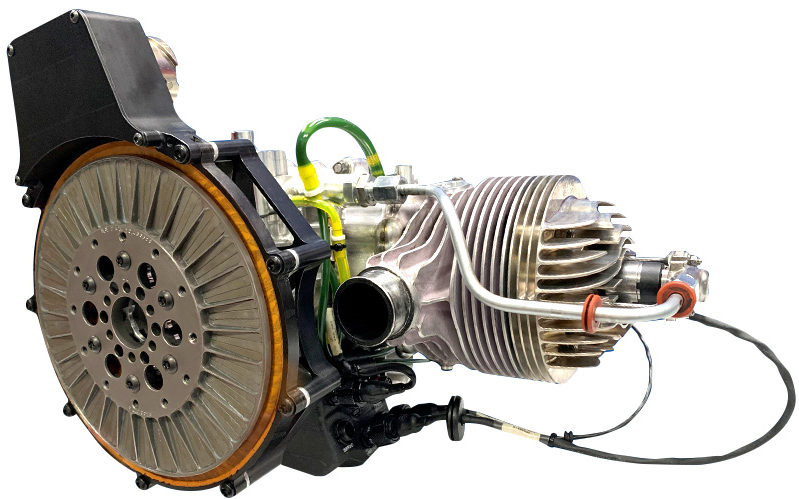
Pictured is a state-of-the-art, heavy-fuel, MIL-SPEC version of LaunchPoint’s 5.5kW system for hybrid-flight defense applications.
GOLETA, California (August 23, 2021) – Fast-growing aerospace startup LaunchPoint Electric Propulsion Solutions, Inc. has released its latest hybrid-electric generator system, a patented design that harnesses the combined power of traditional fuel and electricity to expand the capabilities of drones. The LaunchPoint HPS055 GenSet is a 5.5kW, highly efficient, high-specific power generator and hybrid electric power/engine controller system that utilizes specialized electric machine and GenSet technology to enable extended range flight. Drones installed with the 5.5kW GenSet can travel farther and carry more load than those fitted with other hybrid power system models, expanding the possibilities for these types of aircraft. LaunchPoint’s latest creation builds upon other boundary-pushing technology the company has released in the past year, including a 40kW GenSet and Modeling Advanced Aircraft Propulsion (MAAP™) software suite that can be used to explore a vehicle’s powertrain through multiple configuration scenarios for electric and hybrid-electric aircraft propulsion systems. The 5.5kW GenSet can be utilized in both military and commercial drones and is currently shipping to customers for applications ranging from global security to inspection and mapping to cargo delivery. Demand is expected to continue to grow as the market for electricity-powered aircraft takes off.
“We’re immensely proud of this groundbreaking system. Our master researchers and engineers have spent years optimizing and perfecting our hybrid-electric and electric flight systems, and this newest GenSet is a high point for us,” Chief Technology Officer Michael Ricci said. “We’re excited to get this out into the world and for LaunchPoint to continue fueling the growth of this burgeoning industry.” In addition to its power and range, benefits of the 5.5kW hybrid power system include a battery management system (BMS), in-flight self-charging capability, and liquid-fuel-powered generator. Drone operators can switch between liquid fuel and electricity depending on power demands and have a dependable backup energy supply to complete a mission and land safely in the event that an aircraft runs out of fuel or, alternatively, if the batteries discharge too fully. “Our patented technologies eliminate the risk of several conventional failure modes seen in electric power systems and provide multiple levels of redundancy,” said LaunchPoint’s Vice President of Business Development and Sales, Chris Grieco. “Our highly-intelligent control system actively monitors all aspects of operation during takeoff, hover and cruise flight and landing and responds as needed, assuring both optimal functionality and reliability through mission objectives. This will be seen in real time when the GenSet flies in drones this year for large, key government customers.” This innovative technology is scalable and offers new opportunities for companies working to develop extended-flight, airborne transportation and cargo delivery systems for what is known as the Advanced Air Mobility (AAM) market.
Features of the HPS055 GenSet include:
• 5 kW continuous power/5.5 kW peak at 25 °C ambient and sea level conditions with fuel consumption of 810 g/kWh, self-cooled by air even in hover/zero airspeed conditions
• 7.5+ kW peak power when paired with a recommended 14s battery pack
• Self-starting, in-flight GenSet shutdown and restart capacity
• A LaunchPower™ Power Management Unit (PMU) and Battery Management System (BMS) that enable system monitoring, protection, and power sharing between battery and GenSet to maximize system performance and energy resource utilization in adverse conditions (high-hot). The BMS also enables safe full-discharge and recharge of battery as part of mission profiles
• Controller Area Network (CAN) communications for full system monitoring and control; Can also operate in “stand-alone” mode with only a simple on/off signal from flight controller
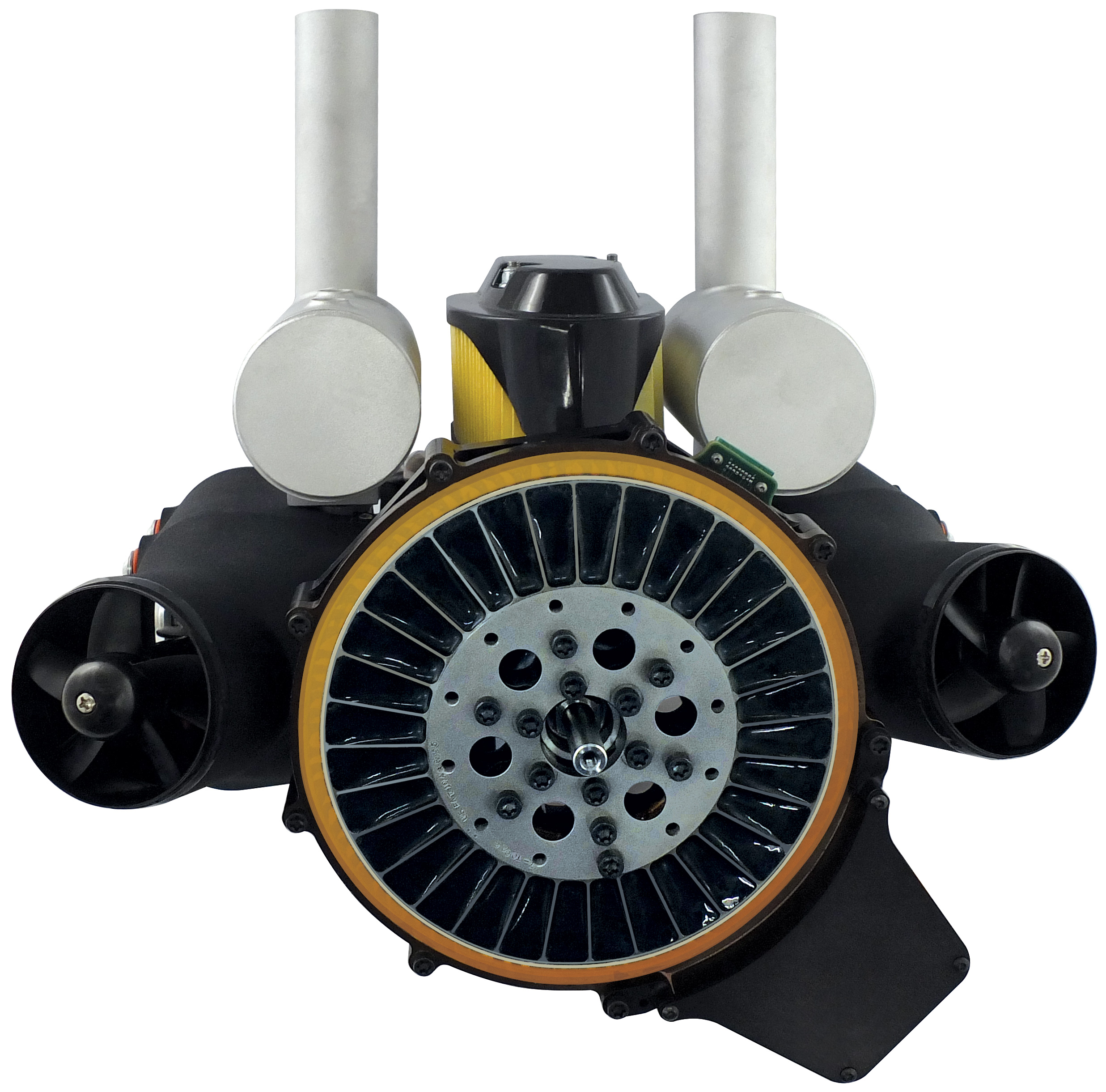
Commercial application of the HPS055 GenSet using a conventional 2-stroke engine.
Started in 2020 as a spinout from Goleta-based technology incubator and think tank, LaunchPoint Technologies, LaunchPoint Electric Propulsion Solutions, Inc. has secured multiple patents, product sales, and contracts for both commercial and government markets. Late last year, the company closed an oversubscribed round of seed funding, which it has used to fuel key investments for new hires, manufacturing capabilities and its growing patent portfolio.
LaunchPoint recently obtained International Organization for Standardization (ISO9001) certification, positioning the company for continued expansion within the global aerospace industry.
– For more information about the LaunchPoint HPS055 GenSet, contact Chris Grieco, Vice President of Business Development and Sales, at 805-679-3072 or via email at
cgrieco@launchpointeps.com
Newest Hybrid Power System from Santa Barbara’s LaunchPoint Pushes the Boundaries of Drone Capabilities
Pictured is a state-of-the-art, heavy-fuel, MIL-SPEC version of LaunchPoint’s 5.5kW system for hybrid-flight defense applications.
GOLETA, California (August 23, 2021) – Fast-growing aerospace startup LaunchPoint Electric Propulsion Solutions, Inc. has released its latest hybrid-electric generator system, a patented design that harnesses the combined power of traditional fuel and electricity to expand the capabilities of drones. The LaunchPoint HPS055 GenSet is a 5.5kW, highly efficient, high-specific power generator and hybrid electric power/engine controller system that utilizes specialized electric machine and GenSet technology to enable extended range flight. Drones installed with the 5.5kW GenSet can travel farther and carry more load than those fitted with other hybrid power system models, expanding the possibilities for these types of aircraft. LaunchPoint’s latest creation builds upon other boundary-pushing technology the company has released in the past year, including a 40kW GenSet and Modeling Advanced Aircraft Propulsion (MAAP™) software suite that can be used to explore a vehicle’s powertrain through multiple configuration scenarios for electric and hybrid-electric aircraft propulsion systems. The 5.5kW GenSet can be utilized in both military and commercial drones and is currently shipping to customers for applications ranging from global security to inspection and mapping to cargo delivery. Demand is expected to continue to grow as the market for electricity-powered aircraft takes off.
“We’re immensely proud of this groundbreaking system. Our master researchers and engineers have spent years optimizing and perfecting our hybrid-electric and electric flight systems, and this newest GenSet is a high point for us,” Chief Technology Officer Michael Ricci said. “We’re excited to get this out into the world and for LaunchPoint to continue fueling the growth of this burgeoning industry.” In addition to its power and range, benefits of the 5.5kW hybrid power system include a battery management system (BMS), in-flight self-charging capability, and liquid-fuel-powered generator. Drone operators can switch between liquid fuel and electricity depending on power demands and have a dependable backup energy supply to complete a mission and land safely in the event that an aircraft runs out of fuel or, alternatively, if the batteries discharge too fully. “Our patented technologies eliminate the risk of several conventional failure modes seen in electric power systems and provide multiple levels of redundancy,” said LaunchPoint’s Vice President of Business Development and Sales, Chris Grieco. “Our highly-intelligent control system actively monitors all aspects of operation during takeoff, hover and cruise flight and landing and responds as needed, assuring both optimal functionality and reliability through mission objectives. This will be seen in real time when the GenSet flies in drones this year for large, key government customers.” This innovative technology is scalable and offers new opportunities for companies working to develop extended-flight, airborne transportation and cargo delivery systems for what is known as the Advanced Air Mobility (AAM) market.
Features of the HPS055 GenSet include:
• 5 kW continuous power/5.5 kW peak at 25 °C ambient and sea level conditions with fuel consumption of 810 g/kWh, self-cooled by air even in hover/zero airspeed conditions
• 7.5+ kW peak power when paired with a recommended 14s battery pack
• Self-starting, in-flight GenSet shutdown and restart capacity
• A LaunchPower™ Power Management Unit (PMU) and Battery Management System (BMS) that enable system monitoring, protection, and power sharing between battery and GenSet to maximize system performance and energy resource utilization in adverse conditions (high-hot). The BMS also enables safe full-discharge and recharge of battery as part of mission profiles
• Controller Area Network (CAN) communications for full system monitoring and control; Can also operate in “stand-alone” mode with only a simple on/off signal from flight controller
Commercial application of the HPS055 GenSet using a conventional 2-stroke engine.
Started in 2020 as a spinout from Goleta-based technology incubator and think tank, LaunchPoint Technologies, LaunchPoint Electric Propulsion Solutions, Inc. has secured multiple patents, product sales, and contracts for both commercial and government markets. Late last year, the company closed an oversubscribed round of seed funding, which it has used to fuel key investments for new hires, manufacturing capabilities and its growing patent portfolio.
LaunchPoint recently obtained International Organization for Standardization (ISO9001) certification, positioning the company for continued expansion within the global aerospace industry.
– For more information about the LaunchPoint HPS055 GenSet, contact Chris Grieco, Vice President of Business Development and Sales, at 805-679-3072 or via email at
cgrieco@launchpointeps.com
Offshore Aviation Completes Test Flight of More Than 90 Minutes with LaunchPoint’s Hybrid UAS Propulsion System
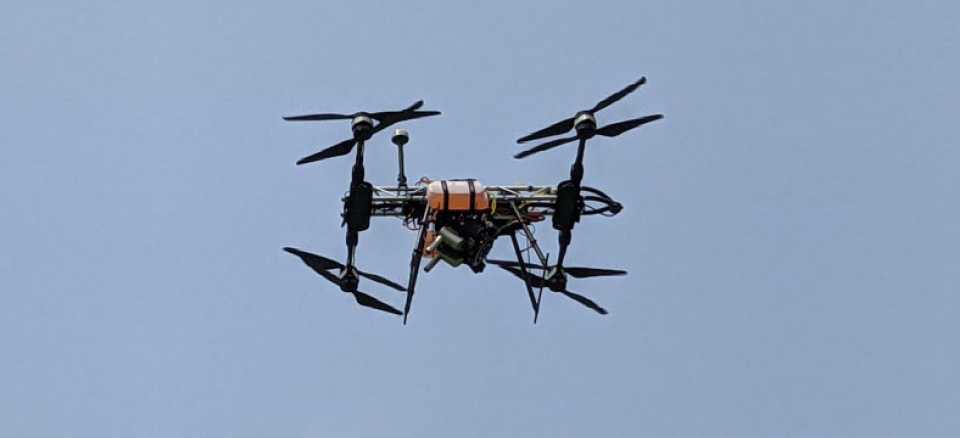
Offshore Aviation Group’s OA-8C (ER) Dragonfly multirotor hover endurance increased to more than 90 minutes in 90-degree Fahrenheit ambient conditions with LaunchPoint’s 5.5 kW hybrid UAS propulsion system
GOLETA, California (August 11, 2021) – Three months after introducing their revolutionary, hybrid GenSet technology for drones, Santa Barbara-based LaunchPoint Electric Propulsion Solutions, Inc. (“LaunchPoint”) announced today in collaboration with Offshore Aviation, the success of their extended flight trials. Offshore tested their advanced unmanned quadcopter aircraft, the OA-8C (ER) Dragonfly, fitted with LaunchPoint’s integrated 5.5 kW hybrid-electric HPS055 GenSet. With LaunchPoint’s flight-extending technology, the Dragonfly’s hover endurance increased to more than 90 minutes in 90-degree Fahrenheit ambient temperature conditions without refueling, effectively tripling the range of current battery-powered drones on the market. In both forward flight and in lower temperatures, endurance is expected to increase. The weight of the test configuration flown was reported at 62 lbs. (28.1 kg) empty with 13 lbs. (5.9 kg) of fuel. The total weight at take-off was 75 lbs. (34.1 kg). “We are excited to announce the success of our test flights of the 5.5 kW GenSets with our partner Offshore Aviation,” stated LaunchPoint CEO Rob Reali. “The trials’ results bring us a big step closer to hybrid-electric flight becoming a commercial reality. With the LaunchPoint Genset, flight time is increased over the incumbent all-electric design by 3x the duration from 30-minutes to a best-in-class time of 90-minutes with an increased payload. We plan to significantly increase that number soon. We’re targeting 4x the endurance or higher with our value engineering efforts in progress to achieve double digit improvements.”
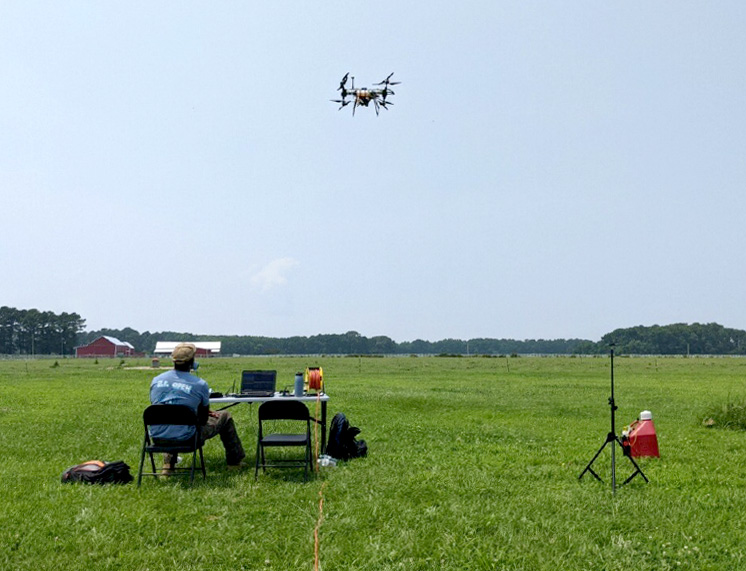
Offshore Aviation Group OA-8C (ER) Dragonfly drone performs flight tests with LaunchPoint’s HPS055 5.5 kW hybrid UAS propulsion system
LaunchPoint’s hybrid-electric GenSets are optimal flight solutions. The GenSets integrate their lightweight electric machines and controllers with engines to produce highly efficient and sophisticated electric power generators that are more power dense than comparable generators. An aircraft equipped with a LaunchPoint GenSet and battery pack enables more than three times the flight duration of those currently available while carrying the same or greater payloads. The HPS055 system produces 0.52 kW/kg continuous power with a peak power output of more than 7 kW using a recommended battery pack in parallel with the GenSet.
Offshore Aviation are world leaders in the development of unmanned aerial systems for defense and commercial use. “The flight of our aircraft with LaunchPoint’s GenSet range-extending capabilities will greatly benefit our current and future defense and commercial clients, including creating new opportunities for use of our novel drones” said Robert Hicks, CEO of the Maryland-based maritime and aviation services company.
In November 2020, LaunchPoint launched its HPS400 (40 kW) GenSet concurrently with its first customer shipments to power large cargo drones and to accommodate future flying vehicle missions that require extended ranges of flight and large payloads. Their innovative technology offers new opportunities for companies in what is known as the Advanced Air Mobility (AAM) markets.
LaunchPoint plans its initial roll-out of GenSets for drone propulsion to the U.S. DoD, U.S. Coast Guard, the U.S. Forestry Service, and in general to the Department of Homeland Security, offering all entities the opportunity to expand their communication, surveillance and delivery capabilities while creating a safer, more reliable environment for those out in the field.
LaunchPoint is attending the upcoming Association for Unmanned Vehicle Systems International (AUVSI) Exposition in Atlanta, Georgia from August 16 – 18, 2021 and will be sharing more information about their GenSet technologies. Please contact Chris Grieco at the below email to arrange a discussion.
About LaunchPoint
LaunchPoint Electric Propulsion Solutions, Inc. is an aerospace propulsion company that specializes in Gensets, motors, and controllers to enable efficient and reliable hybrid-electric and full electric flight for unmanned air vehicles and the advanced air mobility markets. LaunchPoint’s scalable technologies also serve advanced thermal management needs and auxiliary power generation for air and ground applications.
Visit www.LaunchpointEPS.com to learn more about the Company.
– Contact Chris Grieco, Sr. Vice President of Business Development and Sales at cgrieco@launchpointeps.com for more information about the Company’s products.
About Offshore Aviation Group
Offshore Aviation is a Veteran owned company that offers a range of services, designed to support the warfighter. Whether it is fleet support, UAS test and evaluation, target support, or deploying equipment halfway around the world, OAG can quickly and precisely provide you the assets and expertise you need.
Offshore Aviation Completes Test Flight of More Than 90 Minutes with LaunchPoint’s Hybrid UAS Propulsion System
Offshore Aviation Group’s OA-8C (ER) Dragonfly multirotor hover endurance increased to more than 90 minutes in 90-degree Fahrenheit ambient conditions with LaunchPoint’s 5.5 kW hybrid UAS propulsion system
GOLETA, California (August 11, 2021) – Three months after introducing their revolutionary, hybrid GenSet technology for drones, Santa Barbara-based LaunchPoint Electric Propulsion Solutions, Inc. (“LaunchPoint”) announced today in collaboration with Offshore Aviation, the success of their extended flight trials. Offshore tested their advanced unmanned quadcopter aircraft, the OA-8C (ER) Dragonfly, fitted with LaunchPoint’s integrated 5.5 kW hybrid-electric HPS055 GenSet. With LaunchPoint’s flight-extending technology, the Dragonfly’s hover endurance increased to more than 90 minutes in 90-degree Fahrenheit ambient temperature conditions without refueling, effectively tripling the range of current battery-powered drones on the market. In both forward flight and in lower temperatures, endurance is expected to increase. The weight of the test configuration flown was reported at 62 lbs. (28.1 kg) empty with 13 lbs. (5.9 kg) of fuel. The total weight at take-off was 75 lbs. (34.1 kg). “We are excited to announce the success of our test flights of the 5.5 kW GenSets with our partner Offshore Aviation,” stated LaunchPoint CEO Rob Reali. “The trials’ results bring us a big step closer to hybrid-electric flight becoming a commercial reality. With the LaunchPoint Genset, flight time is increased over the incumbent all-electric design by 3x the duration from 30-minutes to a best-in-class time of 90-minutes with an increased payload. We plan to significantly increase that number soon. We’re targeting 4x the endurance or higher with our value engineering efforts in progress to achieve double digit improvements.”
Offshore Aviation Group OA-8C (ER) Dragonfly drone performs flight tests with LaunchPoint’s HPS055 5.5 kW hybrid UAS propulsion system
LaunchPoint’s hybrid-electric GenSets are optimal flight solutions. The GenSets integrate their lightweight electric machines and controllers with engines to produce highly efficient and sophisticated electric power generators that are more power dense than comparable generators. An aircraft equipped with a LaunchPoint GenSet and battery pack enables more than three times the flight duration of those currently available while carrying the same or greater payloads. The HPS055 system produces 0.52 kW/kg continuous power with a peak power output of more than 7 kW using a recommended battery pack in parallel with the GenSet.
Offshore Aviation are world leaders in the development of unmanned aerial systems for defense and commercial use. “The flight of our aircraft with LaunchPoint’s GenSet range-extending capabilities will greatly benefit our current and future defense and commercial clients, including creating new opportunities for use of our novel drones” said Robert Hicks, CEO of the Maryland-based maritime and aviation services company.
In November 2020, LaunchPoint launched its HPS400 (40 kW) GenSet concurrently with its first customer shipments to power large cargo drones and to accommodate future flying vehicle missions that require extended ranges of flight and large payloads. Their innovative technology offers new opportunities for companies in what is known as the Advanced Air Mobility (AAM) markets.
LaunchPoint plans its initial roll-out of GenSets for drone propulsion to the U.S. DoD, U.S. Coast Guard, the U.S. Forestry Service, and in general to the Department of Homeland Security, offering all entities the opportunity to expand their communication, surveillance and delivery capabilities while creating a safer, more reliable environment for those out in the field.
LaunchPoint is attending the upcoming Association for Unmanned Vehicle Systems International (AUVSI) Exposition in Atlanta, Georgia from August 16 – 18, 2021 and will be sharing more information about their GenSet technologies. Please contact Chris Grieco at the below email to arrange a discussion.
About LaunchPoint
LaunchPoint Electric Propulsion Solutions, Inc. is an aerospace propulsion company that specializes in Gensets, motors, and controllers to enable efficient and reliable hybrid-electric and full electric flight for unmanned air vehicles and the advanced air mobility markets. LaunchPoint’s scalable technologies also serve advanced thermal management needs and auxiliary power generation for air and ground applications.
Visit www.LaunchpointEPS.com to learn more about the Company.
– Contact Chris Grieco, Sr. Vice President of Business Development and Sales at cgrieco@launchpointeps.com for more information about the Company’s products.
About Offshore Aviation Group
Offshore Aviation is a Veteran owned company that offers a range of services, designed to support the warfighter. Whether it is fleet support, UAS test and evaluation, target support, or deploying equipment halfway around the world, OAG can quickly and precisely provide you the assets and expertise you need.
LaunchPoint to Present at World’s Leading International Technical Event on Vertical Flight Technology

GOLETA, California 05/10–14/21 – Aerospace propulsion company LaunchPoint Electric Propulsion Solutions, Inc. – a leader in developing electric motors, hybrid-electric propulsion systems and control software for advanced air mobility – is pleased to announce its participation in the Vertical Flight Society’s 77th Annual Forum and Technology Display, being held virtually from May 10 to 14, 2021.
Michael Ricci, LaunchPoint’s Chief Technology Officer and co-founder, will speak on an eVTOL Special Session forum panel about enabling technologies for electric vertical take-off and landing (eVTOL) aircraft. Ricci is the driving force behind LaunchPoint’s “Propulsion by Wire” electric aircraft propulsion system, one of the company’s many cutting-edge innovations. As a panel member, he will share insights based on his extensive development experience in advanced power electronics, electromagnetic and mechanical systems, embedded software development, and control system design.
A prolific member of the Vertical Flight Society (VFS), Ricci has presented at organization events since 2014 when he gave a talk on electric technologies at the inaugural Transformative Vertical Flight Workshop. The workshop was the world’s first gathering of early eVTOL pioneers. Ricci is also a regular contributor and co-author of industry technical papers, has sat on VFS’ eVTOL committee since its founding in 2019, and championed several short courses for eVTOL aircraft aerospace engineers.
“LaunchPoint are world experts in electric motor technology. It has been fantastic that Michael Ricci and LaunchPoint have been so giving of their knowledge and expertise,” VFS Executive Director Mike Hirschberg said. “VFS is all about collaboration and bringing together different technologies and organizations that each have an important part to play, just like eVTOL is a confluence of different technologies that are key to make it happen. LaunchPoint’s technologies and leadership are true enablers that support what we call the Electric VTOL Revolution.”
In addition to his participation at the annual forum, Ricci has been invited to co-instruct the annual VFS short course on eVTOL Technology, to be held in June 2021. The course provides an overview of the unique challenges and opportunities of this new class of vehicles and is taught by leading experts in their fields.
“Ricci and LaunchPoint have been leaders in helping the industry better understand the technology of electric motors, as well as their capabilities and challenges,” said Hirschberg. “We’ve had hundreds of students go through the short course, including myself, and it’s been really eye opening and educational for everyone.”
For his part, Ricci said he is honored to represent LaunchPoint at the VFS forum and as a course instructor. “VFS has been at the heart of eVTOL since the industry’s earliest days, and a great supporter of LaunchPoint,” he said. By sharing his expertise with other VFS members, Ricci hopes to drive transformative change in the emerging eVTOL industry.
“Transformative changes in technology don’t happen through one person or even one company,” Ricci said. “It’s an effort across an entire industry or combination of industries that all work together over many years to solve problems in different disciplines.”
LaunchPoint recently announced the release for broad industry licensing of the Modeling Advanced Aircraft Propulsion (MAAP™) tool, designed to virtually model configuration scenarios for new electric and hybrid-electric aircraft systems. The software tool allows developers to vary power levels, number of rotors, battery and fuel levels, and overall system layout to fast-track design cycle time while optimizing performance and weight. LaunchPoint’s available propulsion products include two versions of its hybrid-electric propulsion systems: the 5 KW hybrid-electric genset for drones and the 40 KW genset for larger drone cargo and future air taxies.
To date, LaunchPoint’s contracted customers include the U.S. Department of Defense as well as Fortune 500 aerospace and automotive companies. Projects include developing hybrid-electric flight technology for the U.S. Army, and “flying car” technology for the U.S. Air Force’s Agility Prime program.
To view the full schedule of events for the Vertical Flight Society’s 77th Annual Forum visit www.vtol.org/forum
LaunchPoint to Present at World’s Leading International Technical Event on Vertical Flight Technology
GOLETA, California 05/10–14/21 – Aerospace propulsion company LaunchPoint Electric Propulsion Solutions, Inc. – a leader in developing electric motors, hybrid-electric propulsion systems and control software for advanced air mobility – is pleased to announce its participation in the Vertical Flight Society’s 77th Annual Forum and Technology Display, being held virtually from May 10 to 14, 2021.
Michael Ricci, LaunchPoint’s Chief Technology Officer and co-founder, will speak on an eVTOL Special Session forum panel about enabling technologies for electric vertical take-off and landing (eVTOL) aircraft. Ricci is the driving force behind LaunchPoint’s “Propulsion by Wire” electric aircraft propulsion system, one of the company’s many cutting-edge innovations. As a panel member, he will share insights based on his extensive development experience in advanced power electronics, electromagnetic and mechanical systems, embedded software development, and control system design.
A prolific member of the Vertical Flight Society (VFS), Ricci has presented at organization events since 2014 when he gave a talk on electric technologies at the inaugural Transformative Vertical Flight Workshop. The workshop was the world’s first gathering of early eVTOL pioneers. Ricci is also a regular contributor and co-author of industry technical papers, has sat on VFS’ eVTOL committee since its founding in 2019, and championed several short courses for eVTOL aircraft aerospace engineers.
“LaunchPoint are world experts in electric motor technology. It has been fantastic that Michael Ricci and LaunchPoint have been so giving of their knowledge and expertise,” VFS Executive Director Mike Hirschberg said. “VFS is all about collaboration and bringing together different technologies and organizations that each have an important part to play, just like eVTOL is a confluence of different technologies that are key to make it happen. LaunchPoint’s technologies and leadership are true enablers that support what we call the Electric VTOL Revolution.”
In addition to his participation at the annual forum, Ricci has been invited to co-instruct the annual VFS short course on eVTOL Technology, to be held in June 2021. The course provides an overview of the unique challenges and opportunities of this new class of vehicles and is taught by leading experts in their fields.
“Ricci and LaunchPoint have been leaders in helping the industry better understand the technology of electric motors, as well as their capabilities and challenges,” said Hirschberg. “We’ve had hundreds of students go through the short course, including myself, and it’s been really eye opening and educational for everyone.”
For his part, Ricci said he is honored to represent LaunchPoint at the VFS forum and as a course instructor. “VFS has been at the heart of eVTOL since the industry’s earliest days, and a great supporter of LaunchPoint,” he said. By sharing his expertise with other VFS members, Ricci hopes to drive transformative change in the emerging eVTOL industry.
“Transformative changes in technology don’t happen through one person or even one company,” Ricci said. “It’s an effort across an entire industry or combination of industries that all work together over many years to solve problems in different disciplines.”
LaunchPoint recently announced the release for broad industry licensing of the Modeling Advanced Aircraft Propulsion (MAAP™) tool, designed to virtually model configuration scenarios for new electric and hybrid-electric aircraft systems. The software tool allows developers to vary power levels, number of rotors, battery and fuel levels, and overall system layout to fast-track design cycle time while optimizing performance and weight. LaunchPoint’s available propulsion products include two versions of its hybrid-electric propulsion systems: the 5 KW hybrid-electric genset for drones and the 40 KW genset for larger drone cargo and future air taxies.
To date, LaunchPoint’s contracted customers include the U.S. Department of Defense as well as Fortune 500 aerospace and automotive companies. Projects include developing hybrid-electric flight technology for the U.S. Army, and “flying car” technology for the U.S. Air Force’s Agility Prime program.
To view the full schedule of events for the Vertical Flight Society’s 77th Annual Forum visit www.vtol.org/forum
LaunchPoint’s Pioneering Electric Aircraft Design Tool, MAAP™, Makes Commercial Debut
•
GOLETA, California 3/8/21 – As transportation and aerospace companies ramp up development of flying vehicles to meet the mobility demands of the future, they face significant up-front costs and modeling uncertainties that slow down the design process.
LaunchPoint Electric Propulsion Solutions, Inc., a Santa Barbara-area aerospace propulsion innovator known for its patented electric motors, hybrid-electric propulsion systems, and control software for drones and flying cars announced today it has released a pioneering tool to help companies fast-track aircraft propulsion systems designs.
The Modeling Advanced Aircraft Propulsion (MAAP™) tool allows developers to virtually model “what if” configuration scenarios for new electric and hybrid-electric aircraft systems including varying power levels, number of rotors, battery and fuel levels and overall system layouts. This means that engineers can discover what a vehicle’s powertrain “looks like” based on different propulsion system models before they build a prototype that may not be optimized or work reliably, thereby avoiding costly mistakes early in the design process.
“MAAP™ will allow companies designing cutting-edge aircraft to shorten design cycle time while unlocking system performance and weight,” said Rob McDonald – former Aircraft Design Lead at Uber Elevate, Industry Expert, and LaunchPoint advisory board member.
“Most vehicle development teams in this space rely on off-the-shelf, commercial systems to meet aggressive timelines. They do not have the luxury of an in-house powertrain design team tooled up to perform complex trades concurrent with the vehicle design or to consider bespoke motors and drives. However, it is through this tight integration of powertrain and vehicle design teams that challenging eVTOL concepts become feasible,” said McDonald. “At LaunchPoint, we have successfully used this tool to develop our own motors, controllers, and propulsion systems for electric flight. With LaunchPoint and MAAP™, any aircraft design team has access to a world-class, in-house motor and drive design capability.”
The MAAP™ tool is available today for broad industry licensing.
LaunchPoint’s announcement of the MAAP™ tool comes at a time when companies are rushing to develop electric and hybrid-electric vertical take-off and landing vehicles (eVTOL) — small and medium-sized aircraft that can be used as flying taxis, cars, and for cargo transportation. The anticipated growth of this market has resulted in many nascent firms being valued as multi-billion dollar companies, leading to a flurry of company mergers, acquisitions and public offerings through partnerships with special purpose acquisition companies (SPACs). LaunchPoint, which originally developed the MAAP™ tool with funding as an Uber Elevate partner, recently completed its first license of the tool to an overseas automaker. Company executives expect the tool will become a key resource for many other fast-growing eVTOL firms.

The MAAP™ tool offers electric and hybrid-electric aircraft designers invaluable trade study results and design optimizations early in the design process.
The MAAP™ tool was used extensively for the development of LaunchPoint’s first products – the 6 KW hybrid-electric genset for drones and the 40 KW genset for larger drone cargo and future air taxis. The company is now employing MAAP™ to create higher-power propulsion system solutions for Advanced Air Mobility (AAM) market applications. The types of aircraft being developed for the AAM markets are widely regarded as the future of urban airborne transportation.
“LaunchPoint is uniquely positioned to work with air vehicle integrators to help design aircraft propulsion systems and to validate designs for the Advanced Air Mobility market,” says Rob Reali, LaunchPoint’s CEO. “In addition to the MAAP™ design tool we also provide a suite of electric motors, controllers, and generator sets that are ideal in certain classes of vehicles this exciting industry is developing.”
MAAP™ Overview
• Optimizes a motor and drive combination at multiple (unlimited) operating points subject to dozens of constraints at each point.
• Operational and design constraints have been identified and modeled based on LaunchPoint’s decades of experience.
• Analyzes the off-design performance of motor and drive combinations.
• Readily performs system-level trade studies including requirements trades, operating point trades, and technology trades – MAAP™ will even perform simultaneous combined trade studies.
• Unlocks weight and performance for your design.
Outputs
• System performance across the operating envelope including: (Indented:)
• Current and voltage at key system nodes,
• Internal and external temperatures,
• Power loss breakdown identifying sources of heat and inefficiency,
• Component and system efficiency, and
• Proximity to all operational constraints.
• System mass including mass breakdown to constituent parts.
• System and component dimensions, including electrical specifications of primary components.
• Virtual specification sheet.
About LaunchPoint
LaunchPoint Electric Propulsion Solutions, Inc. is an aerospace propulsion company whose top-level engineers have more than a decade of experience working together to develop and supply electric motors and hybrid-electric propulsion systems with smart control software for unmanned air vehicles, aerospace power generation, and the Advanced Air Mobility markets. Visit www.LaunchPointEPS.com to learn more about the Company.
Contact Chris Grieco, Vice President of Business Development and Sales at
cgrieco@launchpointeps.com for more information about the MAAP™ tool and the Company’s products.
LaunchPoint’s Pioneering Electric Aircraft Design Tool, MAAP™, Makes Commercial Debut
•
GOLETA, California 3/8/21 – As transportation and aerospace companies ramp up development of flying vehicles to meet the mobility demands of the future, they face significant up-front costs and modeling uncertainties that slow down the design process.
LaunchPoint Electric Propulsion Solutions, Inc., a Santa Barbara-area aerospace propulsion innovator known for its patented electric motors, hybrid-electric propulsion systems, and control software for drones and flying cars announced today it has released a pioneering tool to help companies fast-track aircraft propulsion systems designs.
The Modeling Advanced Aircraft Propulsion (MAAP™) tool allows developers to virtually model “what if” configuration scenarios for new electric and hybrid-electric aircraft systems including varying power levels, number of rotors, battery and fuel levels and overall system layouts. This means that engineers can discover what a vehicle’s powertrain “looks like” based on different propulsion system models before they build a prototype that may not be optimized or work reliably, thereby avoiding costly mistakes early in the design process.
“MAAP™ will allow companies designing cutting-edge aircraft to shorten design cycle time while unlocking system performance and weight,” said Rob McDonald – former Aircraft Design Lead at Uber Elevate, Industry Expert, and LaunchPoint advisory board member.
“Most vehicle development teams in this space rely on off-the-shelf, commercial systems to meet aggressive timelines. They do not have the luxury of an in-house powertrain design team tooled up to perform complex trades concurrent with the vehicle design or to consider bespoke motors and drives. However, it is through this tight integration of powertrain and vehicle design teams that challenging eVTOL concepts become feasible,” said McDonald. “At LaunchPoint, we have successfully used this tool to develop our own motors, controllers, and propulsion systems for electric flight. With LaunchPoint and MAAP™, any aircraft design team has access to a world-class, in-house motor and drive design capability.”
The MAAP™ tool is available today for broad industry licensing.
LaunchPoint’s announcement of the MAAP™ tool comes at a time when companies are rushing to develop electric and hybrid-electric vertical take-off and landing vehicles (eVTOL) — small and medium-sized aircraft that can be used as flying taxis, cars, and for cargo transportation. The anticipated growth of this market has resulted in many nascent firms being valued as multi-billion dollar companies, leading to a flurry of company mergers, acquisitions and public offerings through partnerships with special purpose acquisition companies (SPACs). LaunchPoint, which originally developed the MAAP™ tool with funding as an Uber Elevate partner, recently completed its first license of the tool to an overseas automaker. Company executives expect the tool will become a key resource for many other fast-growing eVTOL firms.
The MAAP™ tool offers electric and hybrid-electric aircraft designers invaluable trade study results and design optimizations early in the design process.
The MAAP™ tool was used extensively for the development of LaunchPoint’s first products – the 6 KW hybrid-electric genset for drones and the 40 KW genset for larger drone cargo and future air taxis. The company is now employing MAAP™ to create higher-power propulsion system solutions for Advanced Air Mobility (AAM) market applications. The types of aircraft being developed for the AAM markets are widely regarded as the future of urban airborne transportation.
“LaunchPoint is uniquely positioned to work with air vehicle integrators to help design aircraft propulsion systems and to validate designs for the Advanced Air Mobility market,” says Rob Reali, LaunchPoint’s CEO. “In addition to the MAAP™ design tool we also provide a suite of electric motors, controllers, and generator sets that are ideal in certain classes of vehicles this exciting industry is developing.”
MAAP™ Overview
• Optimizes a motor and drive combination at multiple (unlimited) operating points subject to dozens of constraints at each point.
• Operational and design constraints have been identified and modeled based on LaunchPoint’s decades of experience.
• Analyzes the off-design performance of motor and drive combinations.
• Readily performs system-level trade studies including requirements trades, operating point trades, and technology trades – MAAP™ will even perform simultaneous combined trade studies.
• Unlocks weight and performance for your design.
Outputs
• System performance across the operating envelope including: (Indented:)
• Current and voltage at key system nodes,
• Internal and external temperatures,
• Power loss breakdown identifying sources of heat and inefficiency,
• Component and system efficiency, and
• Proximity to all operational constraints.
• System mass including mass breakdown to constituent parts.
• System and component dimensions, including electrical specifications of primary components.
• Virtual specification sheet.
About LaunchPoint
LaunchPoint Electric Propulsion Solutions, Inc. is an aerospace propulsion company whose top-level engineers have more than a decade of experience working together to develop and supply electric motors and hybrid-electric propulsion systems with smart control software for unmanned air vehicles, aerospace power generation, and the Advanced Air Mobility markets. Visit www.LaunchPointEPS.com to learn more about the Company.
Contact Chris Grieco, Vice President of Business Development and Sales at
cgrieco@launchpointeps.com for more information about the MAAP™ tool and the Company’s products.
New Aerospace Firm, LaunchPoint EPS, Prepared for Takeoff into Electric Aircraft Markets
Seasoned startup executive, Robert Reali, to lead venture
GOLETA, California 11/5/2020 – A team of high-level engineers and business executives from Santa Barbara are betting big on the future of electric-powered flight with the formation of a new startup, LaunchPoint Electric Propulsion Solutions (LaunchPoint EPS).
The fledgling aerospace firm emerges from longstanding, Goleta-based technology incubator and think tank, LaunchPoint Technologies, a leader in cutting-edge engineering design. LaunchPoint EPS will specialize in supplying cutting edge modeling and design software, hardware in the form of electric motors, hybrid gensets and controllers, and control software for the world’s fast-growing electric-and hybrid-electric-powered aircraft sector. This includes flight applications under development by companies such as major automotive companies, Uber and its air taxi affiliates and the U.S. military, ranging from cargo-carrying drones to airborne passenger taxis.
Robert Reali, an experienced leader of early-stage technology companies, will serve as LaunchPoint EPS’ Chief Executive Officer. Reali was previously chief operations officer for Santa Barbara-based startup TrueVision where he helped grow the company from four employees to a major eye-surgery device firm that was acquired by Alcon (a division of Novartis) in 2019.
LaunchPoint EPS has acquired all the assets and know-how of LaunchPoint Technologies related to the electric motor, hybrid-electric gensets and controller business including patents, intellectual property and proprietary processes, contracts, product orders, inventory, facilities, key personnel, and employees.
“The new company is focused on serving the surging urban air mobility market which has increased the demand for our power-dense electric motors and control software by the world’s largest players in this space,” said Reali. “The main reason for the spinout from LaunchPoint Technologies is to focus on shipping the products we invented. However, we will also continue the tradition of developing innovative new products to address market needs.”
LaunchPoint Technologies co-founders UCSB Professor Emeritus Dr. Brad Paden and brother, Dave Paden, will be part of the LaunchPoint EPS management team serving as Chief Scientist and VP of Manufacturing, respectively, along with former CEO and now LaunchPoint EPS Chief Technology Officer Mike Ricci, and Engineering Director Brian J. Clark. Chris Grieco, previously Executive Vice President of bulk energy storage company Gravity Power, LLC, will serve as LaunchPoint EPS’ Vice President for Global Business Development and Sales.
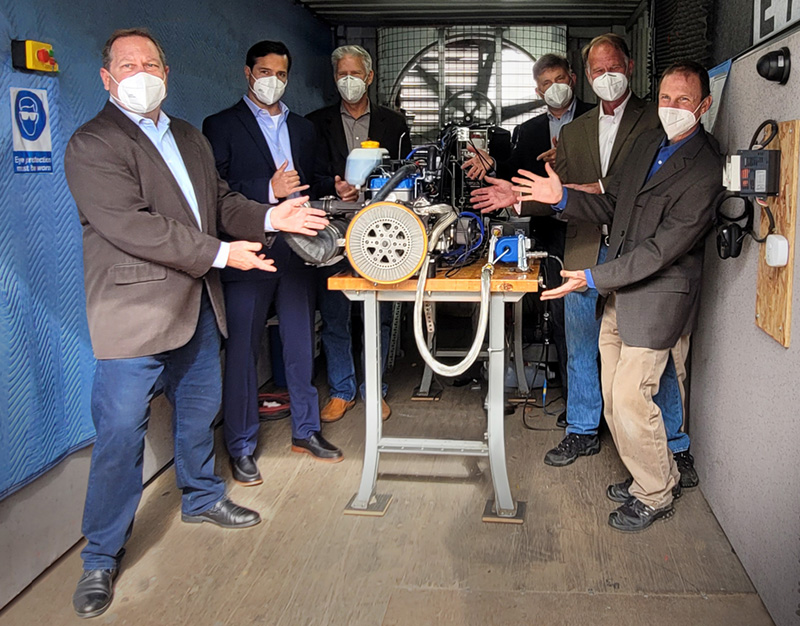
LaunchPoint EPS executive team shown accompanying their industry-first genset for the emerging electric aviation markets.
Photo L-R: Robert Reali (Chief Executive Officer); Brian Clark (Engineering Director); Brad Paden (Chief Scientist); Chris Grieco (VP of Business Development & Sales); Dave Paden (VP of Manufacturing); and Mike Ricci (Chief Technology Officer).
New Aerospace Firm, LaunchPoint EPS, Prepared for Takeoff into Electric Aircraft Markets
Seasoned startup executive, Robert Reali, to lead venture
GOLETA, California 11/5/2020 – A team of high-level engineers and business executives from Santa Barbara are betting big on the future of electric-powered flight with the formation of a new startup, LaunchPoint Electric Propulsion Solutions (LaunchPoint EPS).
The fledgling aerospace firm emerges from longstanding, Goleta-based technology incubator and think tank, LaunchPoint Technologies, a leader in cutting-edge engineering design. LaunchPoint EPS will specialize in supplying cutting edge modeling and design software, hardware in the form of electric motors, hybrid gensets and controllers, and control software for the world’s fast-growing electric-and hybrid-electric-powered aircraft sector. This includes flight applications under development by companies such as major automotive companies, Uber and its air taxi affiliates and the U.S. military, ranging from cargo-carrying drones to airborne passenger taxis.
Robert Reali, an experienced leader of early-stage technology companies, will serve as LaunchPoint EPS’ Chief Executive Officer. Reali was previously chief operations officer for Santa Barbara-based startup TrueVision where he helped grow the company from four employees to a major eye-surgery device firm that was acquired by Alcon (a division of Novartis) in 2019.
LaunchPoint EPS has acquired all the assets and know-how of LaunchPoint Technologies related to the electric motor, hybrid-electric gensets and controller business including patents, intellectual property and proprietary processes, contracts, product orders, inventory, facilities, key personnel, and employees.
“The new company is focused on serving the surging urban air mobility market which has increased the demand for our power-dense electric motors and control software by the world’s largest players in this space,” said Reali. “The main reason for the spinout from LaunchPoint Technologies is to focus on shipping the products we invented. However, we will also continue the tradition of developing innovative new products to address market needs.”
LaunchPoint Technologies co-founders UCSB Professor Emeritus Dr. Brad Paden and brother, Dave Paden, will be part of the LaunchPoint EPS management team serving as Chief Scientist and VP of Manufacturing, respectively, along with former CEO and now LaunchPoint EPS Chief Technology Officer Mike Ricci, and Engineering Director Brian J. Clark. Chris Grieco, previously Executive Vice President of bulk energy storage company Gravity Power, LLC, will serve as LaunchPoint EPS’ Vice President for Global Business Development and Sales.
LaunchPoint EPS executive team shown accompanying their industry-first genset for the emerging electric aviation markets.
Photo L-R: Robert Reali (Chief Executive Officer); Brian Clark (Engineering Director); Brad Paden (Chief Scientist); Chris Grieco (VP of Business Development & Sales); Dave Paden (VP of Manufacturing); and Mike Ricci (Chief Technology Officer).
Budding Electric Aerospace Propulsion Supplier LaunchPoint Piling up Early Milestones
Company begins shipping products to customers and secures new U.S. Department of Defense contracts.
GOLETA, California – LaunchPoint Electric Propulsion Solutions, a pioneering California startup that models and produces electric motors and hybrid-electric propulsion systems for the aerospace industry, has hit several milestones in its first six months in business.
The fledgling aerospace development firm has begun shipping two versions of its hybrid-electric propulsion systems to commercial and defense customers. To date, the Company’s contracted customers include the U.S. DOD, large U.S. DOD contractors, aerospace and automotive companies, and more.
LaunchPoint’s initial products – the 6KW hybrid-electric genset for drones and the 40KW gensets for larger drone cargo and future air taxis – are designed for extended-range flights and expanded mission capabilities. Future products in planning now address the coming, higher-power Urban Air Mobility market applications. These low-altitude passenger-carrying aircraft utilizing hybrid-electric and pure electric flight are widely regarded as the future of aerospace for urban transportation.
The company plans to test its proprietary flight products with drone customers through the first quarter of 2021. Company executives expect a larger volume of sales to follow as demonstrations and testing garner visibility from large customers globally.
“We have more than doubled in size since June and continue to hire key personnel and implement manufacturing upgrades. We are seeing exponential interest in our advanced modeling tools and products for both drones and the future Urban Air Mobility markets” said Rob Reali, LaunchPoint’s CEO.
Reali said the Company is constantly expanding its patent portfolio, providing protection for the firm’s engineering breakthroughs within a growing field of international competitors. As the markets grow, LaunchPoint expects to lock up critical intellectual property in the space, Reali said.
In addition to its commercial contracts and orders, the company has received a $1 million Small Business Innovation Research grant from the U.S. Army to further develop its technology for hybrid- electric flight. The U.S. Department of Defense also recently awarded LaunchPoint and its partner Georgia Tech two contracts to help develop flying car technology for the U.S. Air Force’s Agility Prime program.
“We applaud the vision of the U.S. Department of Defense in helping fast-track development of this technology,” said Chris Grieco, LaunchPoint’s global vice president of business development and sales. “Ultimately, it will require a solid investment from the U.S. government to ensure the electric flight industry achieves its full potential through certification. This combined with the very large, global strategic moves now being made by the conventional aerospace firms, automotive companies and well-backed, experienced, private developers leaves no doubt this is a dawn of a major industry.”
LaunchPoint is also collaborating with the U.S. Department of Energy’s National Renewable Energy Laboratory (NREL) in Colorado under a Cooperative Research and Development Agreement (CRADA) to explore advanced manufacturing techniques for its lightweight aerospace motors.

Pictured is our newly released 40kW genset product which began shipping globally to customers in November 2020
Budding Electric Aerospace Propulsion Supplier LaunchPoint Piling up Early Milestones
Company begins shipping products to customers and secures new U.S. Department of Defense contracts.
GOLETA, California – LaunchPoint Electric Propulsion Solutions, a pioneering California startup that models and produces electric motors and hybrid-electric propulsion systems for the aerospace industry, has hit several milestones in its first six months in business.
The fledgling aerospace development firm has begun shipping two versions of its hybrid-electric propulsion systems to commercial and defense customers. To date, the Company’s contracted customers include the U.S. DOD, large U.S. DOD contractors, aerospace and automotive companies, and more.
LaunchPoint’s initial products – the 6KW hybrid-electric genset for drones and the 40KW gensets for larger drone cargo and future air taxis – are designed for extended-range flights and expanded mission capabilities. Future products in planning now address the coming, higher-power Urban Air Mobility market applications. These low-altitude passenger-carrying aircraft utilizing hybrid-electric and pure electric flight are widely regarded as the future of aerospace for urban transportation.
The company plans to test its proprietary flight products with drone customers through the first quarter of 2021. Company executives expect a larger volume of sales to follow as demonstrations and testing garner visibility from large customers globally.
“We have more than doubled in size since June and continue to hire key personnel and implement manufacturing upgrades. We are seeing exponential interest in our advanced modeling tools and products for both drones and the future Urban Air Mobility markets” said Rob Reali, LaunchPoint’s CEO.
Reali said the Company is constantly expanding its patent portfolio, providing protection for the firm’s engineering breakthroughs within a growing field of international competitors. As the markets grow, LaunchPoint expects to lock up critical intellectual property in the space, Reali said.
In addition to its commercial contracts and orders, the company has received a $1 million Small Business Innovation Research grant from the U.S. Army to further develop its technology for hybrid- electric flight. The U.S. Department of Defense also recently awarded LaunchPoint and its partner Georgia Tech two contracts to help develop flying car technology for the U.S. Air Force’s Agility Prime program.
“We applaud the vision of the U.S. Department of Defense in helping fast-track development of this technology,” said Chris Grieco, LaunchPoint’s global vice president of business development and sales. “Ultimately, it will require a solid investment from the U.S. government to ensure the electric flight industry achieves its full potential through certification. This combined with the very large, global strategic moves now being made by the conventional aerospace firms, automotive companies and well-backed, experienced, private developers leaves no doubt this is a dawn of a major industry.”
LaunchPoint is also collaborating with the U.S. Department of Energy’s National Renewable Energy Laboratory (NREL) in Colorado under a Cooperative Research and Development Agreement (CRADA) to explore advanced manufacturing techniques for its lightweight aerospace motors.
Pictured is our newly released 40kW genset product which began shipping globally to customers in November 2020
 FOR IMMEDIATE RELEASE
Contact: Jennifer Goddard Combs
805-565-3990
jennifer@thegoddardcompany.com
Aerospace Startup, LaunchPoint, Releases New
Hybrid Generator for Electricity-Powered Flight
•
GOLETA, California – A newly released, hybrid-electric generator system developed by Santa Barbara-area startup, LaunchPoint, opens up new possibilities in the fast-growing field of hybrid electric-powered flight. The product is currently available only from LaunchPoint and is shipping to domestic and global customers.
Created by a team of elite engineers over a decade, the LaunchPoint HPS400 GenSet is a 40kW generator with the capacity to power large drones and flying vehicle missions that require extended ranges of flight. This innovative technology offers new opportunities for companies working to develop extended-flight, airborne transportation, and cargo delivery systems for what’s known as the Advanced Air Mobility (AAM) markets.
Until now, the 40kW market has been underserved. LaunchPoint developed the HPS400 GenSet with the goal of fulfilling this unmet demand, and sales of the product have been swift since its release.
“We’re thrilled to announce the launch of this 40kW hybrid power system,” said Rob Reali, LaunchPoint’s CEO. “Given our work the past ten years in the space, we know this is a product that the market wants and needs, and we’re excited to see how quickly the AAM markets continue to adopt our hybrid electric propulsion systems.”
Highly efficient and power-dense, the HPS400 GenSet uses LaunchPoint-patented technology including an air-cooled alternator, lightweight aircraft engine, software and controls and a battery management system that allows for in-flight battery charging.
Other features include SmartPoint™ Control Software, an air-cooled alternator and electronics, CAN communications to the flight controller for monitoring system status, automatic throttle control to match the bus load and share power with the battery, and fans and radiators sized to ensure sufficient engine cooling in hover and other low airflow conditions.
LaunchPoint is delivering the new 40kW genset along with its 6kW hybrid-electric genset to commercial aerospace, automotive and air taxi companies globally. The firm has also secured more than$1.25 million in grants from the U.S. Department of Defense to develop hybrid-electric flight technology for flying cars.
Started six months ago as a spinout from Goleta-based technology incubator and think tank, LaunchPoint Technologies, LaunchPoint has already secured multiple patents, product sales, and contracts for both commercial and government markets. The Company plans to further expand its team and manufacturing capabilities in the coming months to meet growing demand for electric flight propulsion systems.
For more information about the LaunchPoint HPS400 GenSet, contact Chris Grieco, Vice President of Business Development and Sales, at 1-805-679-3072 or via email at cgrieco@launchpointeps.com
LaunchPoint EPS is located at 5735 Hollister Ave., Suite B, in Goleta. For more information call 805-683-9659 or visit https://www.launchpointEPS.com/
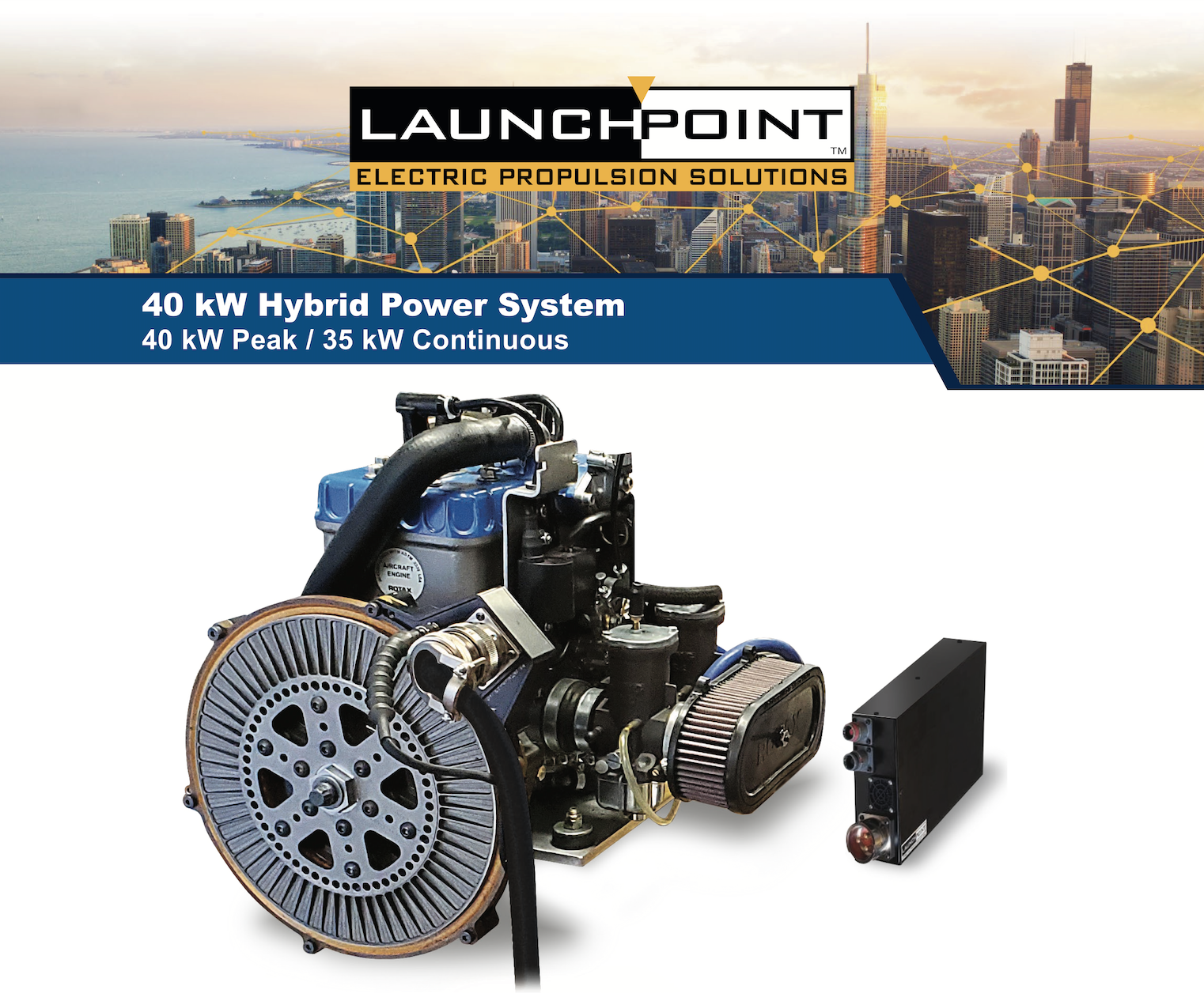
FOR IMMEDIATE RELEASE
Contact: Jennifer Goddard Combs
805-565-3990
jennifer@thegoddardcompany.com
Aerospace Startup, LaunchPoint, Releases New
Hybrid Generator for Electricity-Powered Flight
•
GOLETA, California – A newly released, hybrid-electric generator system developed by Santa Barbara-area startup, LaunchPoint, opens up new possibilities in the fast-growing field of hybrid electric-powered flight. The product is currently available only from LaunchPoint and is shipping to domestic and global customers.
Created by a team of elite engineers over a decade, the LaunchPoint HPS400 GenSet is a 40kW generator with the capacity to power large drones and flying vehicle missions that require extended ranges of flight. This innovative technology offers new opportunities for companies working to develop extended-flight, airborne transportation, and cargo delivery systems for what’s known as the Advanced Air Mobility (AAM) markets.
Until now, the 40kW market has been underserved. LaunchPoint developed the HPS400 GenSet with the goal of fulfilling this unmet demand, and sales of the product have been swift since its release.
“We’re thrilled to announce the launch of this 40kW hybrid power system,” said Rob Reali, LaunchPoint’s CEO. “Given our work the past ten years in the space, we know this is a product that the market wants and needs, and we’re excited to see how quickly the AAM markets continue to adopt our hybrid electric propulsion systems.”
Highly efficient and power-dense, the HPS400 GenSet uses LaunchPoint-patented technology including an air-cooled alternator, lightweight aircraft engine, software and controls and a battery management system that allows for in-flight battery charging.
Other features include SmartPoint™ Control Software, an air-cooled alternator and electronics, CAN communications to the flight controller for monitoring system status, automatic throttle control to match the bus load and share power with the battery, and fans and radiators sized to ensure sufficient engine cooling in hover and other low airflow conditions.
LaunchPoint is delivering the new 40kW genset along with its 6kW hybrid-electric genset to commercial aerospace, automotive and air taxi companies globally. The firm has also secured more than$1.25 million in grants from the U.S. Department of Defense to develop hybrid-electric flight technology for flying cars.
Started six months ago as a spinout from Goleta-based technology incubator and think tank, LaunchPoint Technologies, LaunchPoint has already secured multiple patents, product sales, and contracts for both commercial and government markets. The Company plans to further expand its team and manufacturing capabilities in the coming months to meet growing demand for electric flight propulsion systems.
For more information about the LaunchPoint HPS400 GenSet, contact Chris Grieco, Vice President of Business Development and Sales, at 1-805-679-3072 or via email at cgrieco@launchpointeps.com
LaunchPoint EPS is located at 5735 Hollister Ave., Suite B, in Goleta. For more information call 805-683-9659 or visit https://www.launchpointEPS.com/